The short answer
Start with the measurements, because the garage door tracks and opener set your real ceiling. Then plan power and network, lighting, a cushioned floor, the screen position and the climate, in that order. A mat-and-net setup can fit a 10 by 10 foot bay with a 9 foot ceiling, while a projector enclosure needs more length.
The dashed circle is the path of the clubhead around the golfer's shoulders. A common rule of thumb is ceiling height of about golfer height plus club length (see the room size calculator), but a real swing is the only test.
A garage is the most common place to build a simulator, and it is also full of obstacles that a spare room does not have: a door on tracks, an opener in the ceiling, bare concrete, no heating and a car that needs a home. This plan walks through the build in the order that avoids rework. Treat it as a checklist, not a guarantee, because every garage is different.
The nine steps at a glance:
| Step | Decide | Common trap |
|---|---|---|
| 1. Measure | Bay width, length and height at the hitting spot | Measuring at the wall instead of where you stand |
| 2. Ceiling | The lowest door track, opener, pipe or light | Forgetting the door tracks |
| 3. Layout | Net, enclosure or retractable screen | Overlapping the car’s footprint |
| 4. Power and network | Outlets, circuit, cable runs | Outlets only at floor level behind the mat |
| 5. Lighting | Indirect, dimmable, flicker-free LED | Harsh shadows on the ball |
| 6. Floor | Mat on cushion over concrete | Skipping the underlay |
| 7. Screen | Enclosure, screen and projector position | Projector in the swing path |
| 8. Climate | Heat, cold, damp, security | Electronics left in a freezing garage |
| 9. Test | Swing every club before finishing | Finishing the walls first |
Step 1: Measure the bay
Shop Indoor Golf’s garage page gives starting sizes. A mat-and-net setup fits in about 10 ft wide by 10 ft long by 9 ft high. Its SkyTrak SIG10 enclosure recommends 11 ft wide by 16 ft long by 9 ft high, and it says to add 6 ft of length when you include a projector with a SIGPRO enclosure. Its SIG8 needs only 9 ft of total width.
For a full projector bay, the room-size tables are the better guide. Carl’s Place builds depth as 1 ft behind the screen, 10 to 12 ft from the ball to the screen and 4 to 7 ft behind the golfer, which gives 15 ft minimum and 18 to 20 ft recommended. The full numbers are in the room-size guide.
Measure at the hitting spot, not at the wall. Golfbays advises measuring three times, ceiling at the hitting position and width at shoulder height.
Step 2: Find the lowest thing in the ceiling
In a garage the ceiling surface may not be the limit. The door tracks, the opener rail and any lights can hang lower than the joists. Measure to those. Carl’s Place says to map the lowest obstruction in the swing zone, and the same logic applies to a garage.
Then compare that height to your swing. The ceiling-height page shows how to mark your longest club’s arc and add 6 to 9 inches. Remember that the mat takes 2 to 3 inches.
Step 3: Pick the layout
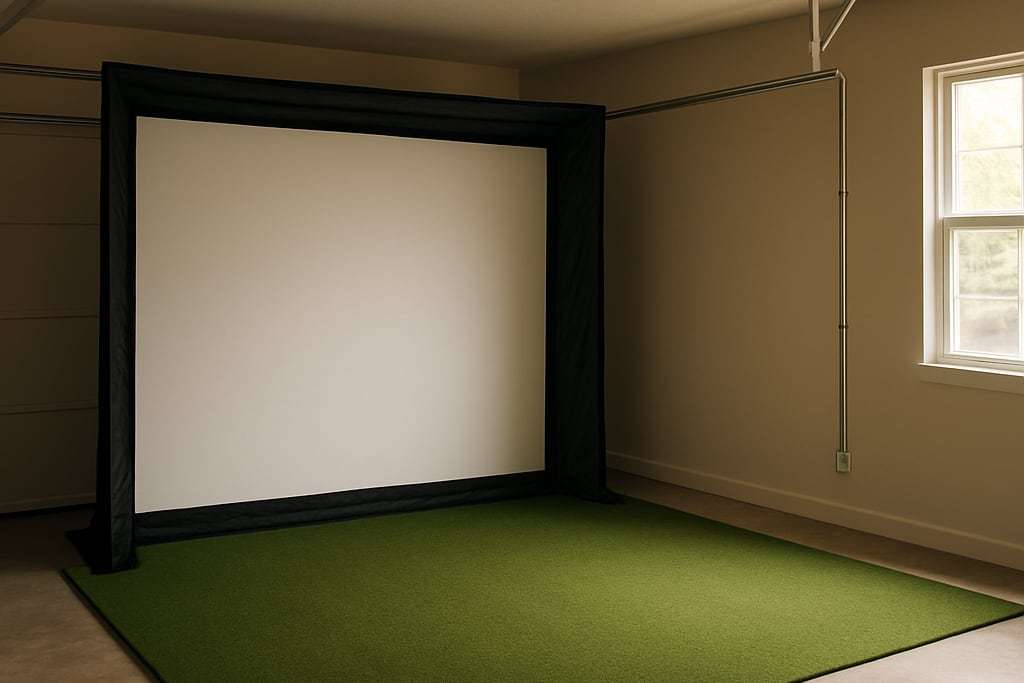
Draw the bay on paper before you buy anything. Include the screen, the tee, the space behind the golfer and the buffer behind the screen. Shop Indoor Golf says the screen should sit 12 to 16 inches from the wall behind it, and Carl’s Place says at least 12 inches.
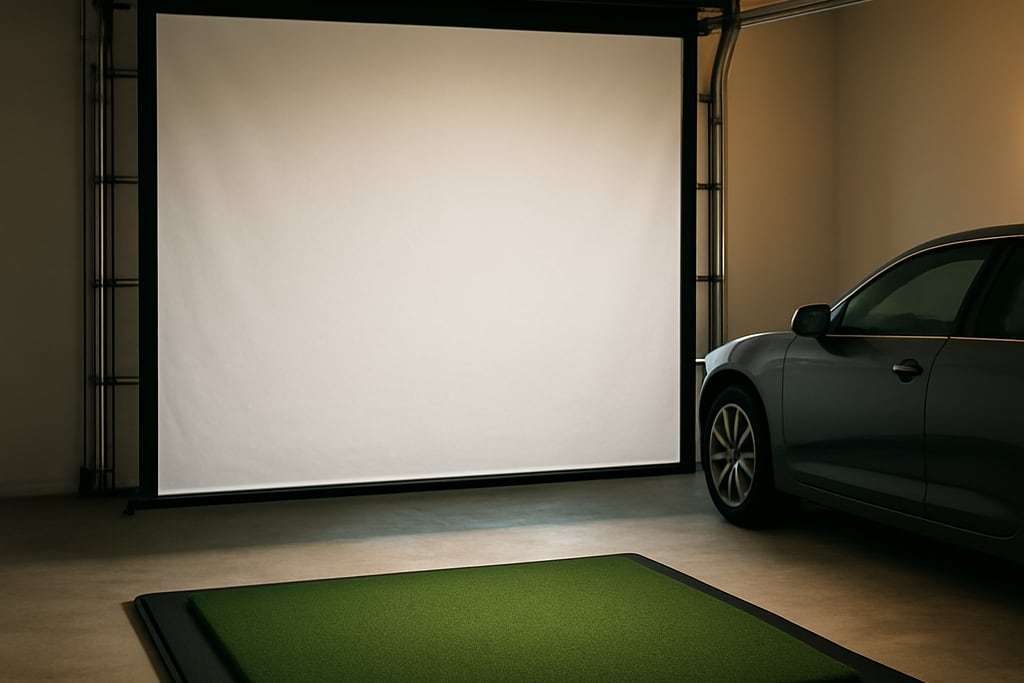
Decide where the car goes. A fixed bay means the car lives elsewhere. A retractable one means more work each time. Shop Indoor Golf describes the G-Trak retractable screen as attaching to the existing garage door rails and retracting for storage, though it gives no door dimensions, so confirm the fit with the seller.
Step 4: Power and network
Equipment draw is roughly 2,000 to 2,500 W, according to Golfer’s Authority. With a 20 percent margin it recommends planning for about 3,000 W and using a dedicated 20 A, 120 V circuit. One simulator maker’s manual calls for a dedicated 15 A circuit, so confirm what your equipment’s maker says.
Do not rely on a guide for this step. A qualified electrician should confirm circuit capacity, grounding and surge protection and tell you whether your town needs a permit. Golfjoy also advises putting outlets near the control station and the projector mount rather than only at floor level behind the hitting area.
Plan the network at the same time. If WiFi does not reach the garage, Shop Indoor Golf suggests an extender, a mesh system or Ethernet. Some monitors need a wired connection. The Uneekor EYE MINI LITE, for example, is listed as Ethernet only. Run cables before any wall or ceiling is closed.
Step 5: Lighting
Shop Indoor Golf recommends uniform, indirect, flicker-free LED lighting that can be dimmed, with natural light cut down by shades. Flicker matters because cameras read it. If you use a projector, a darker room gives a brighter, cleaner image, as Carl’s Place notes for basements, and a garage with windows or a door window will need blocking.
Step 6: Floor
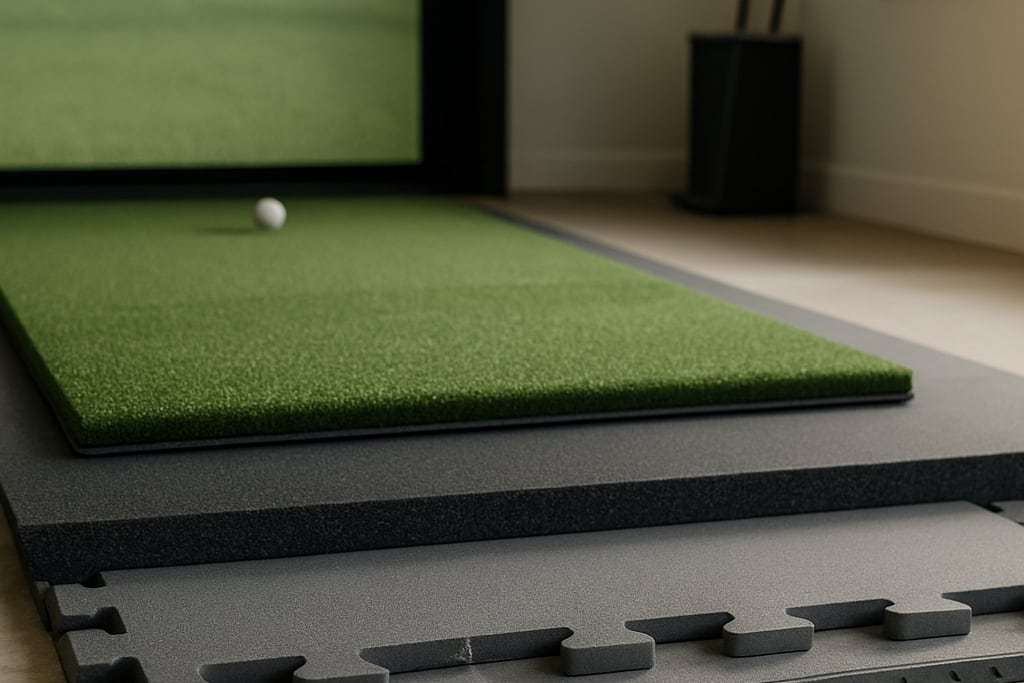
A garage slab is hard and cold. Golfer’s Authority suggests 1.5 in foam board or 2 to 4 in rubber mats under the hitting mat, with 5/8 in gym mats as a budget option. Shop Indoor Golf lists landing pad turf and golf simulator flooring as upgrades for a stable base. The full layering and joint advice is in the flooring guide.
Mats for sim use start from $399 for a SwingTurf mat and $499.95 for the Carl’s Place HotShot mat. Sellers say foam under the turf protects joints, but no independent test links foam thickness to injury, so treat that as general advice, not medicine.
Step 7: Screen, enclosure and projector
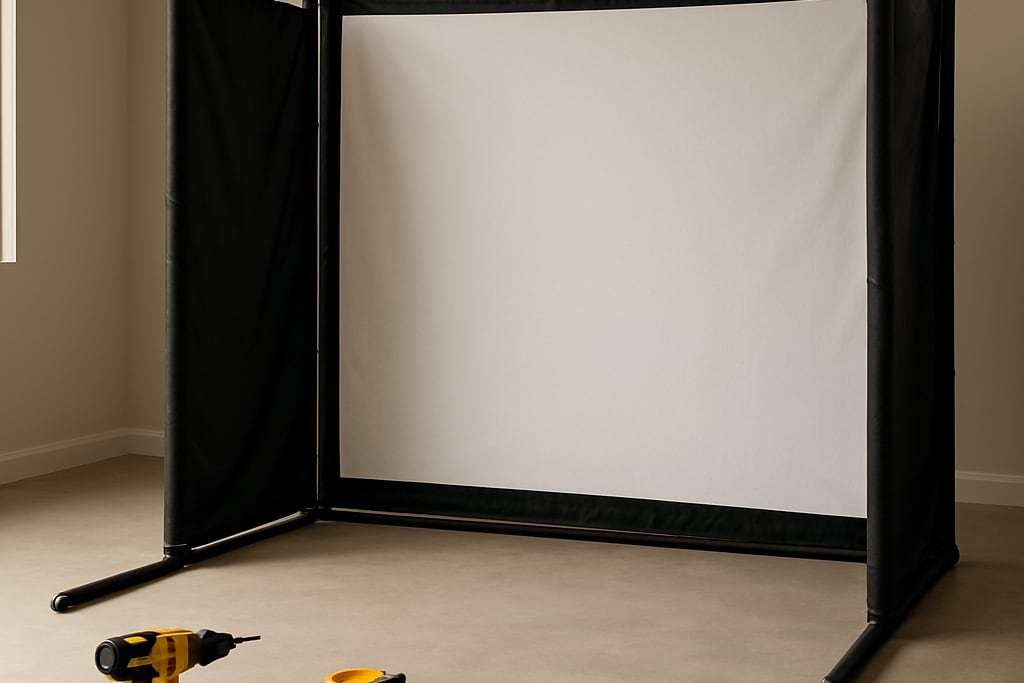
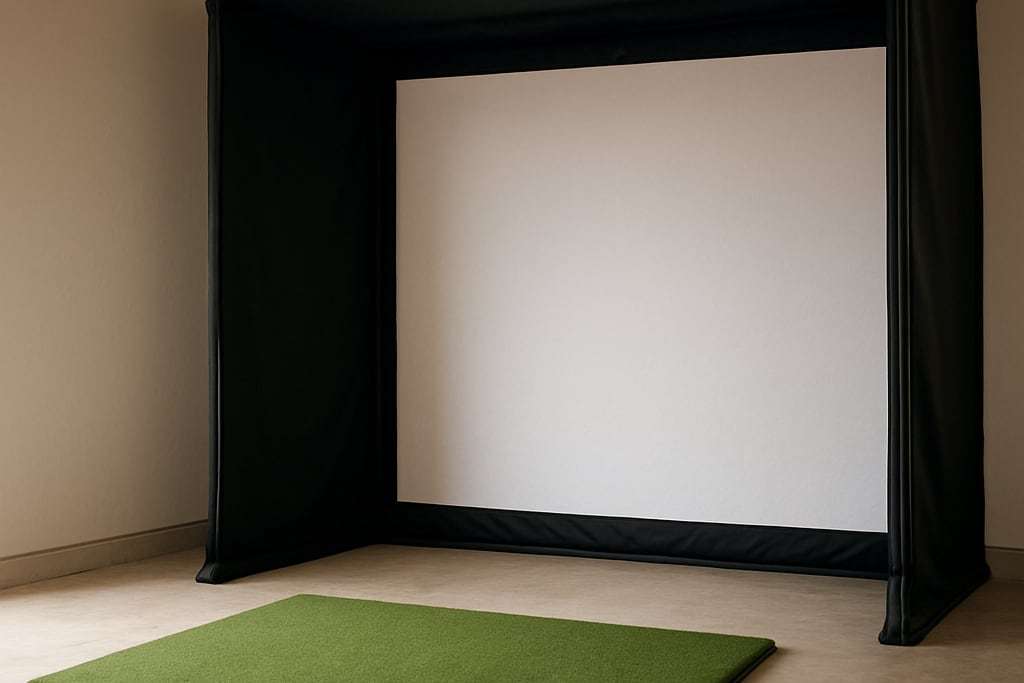
An enclosure gives you the frame, screen and side panels in one kit. Carl’s Place’s DIY enclosure kit starts from $999.95, and the SIG8 package with an MLM2XPRO is $2,899.99. The DIY enclosure guide covers frames, fabric and padding.
Keep the projector out of the line of fire. BenQ says to mount a short-throw projector on the target line 7 to 8 ft from the screen to avoid ball strikes; the projector setup guide has the other mounting options. For brightness, PlayBetter says 3,000 or more lumens suits bright spaces such as garages.
Step 8: Climate and security
Shop Indoor Golf says to protect electronics from extreme cold or heat and to consider AC or heating, though it gives no range. BenQ suggests insulating the walls and door, hanging thermal curtains and using portable heaters. Humidity and condensation can matter more than cold. Keep the launch monitor and laptop indoors between sessions and run a dehumidifier if the garage is damp.
Shop Indoor Golf also advises cameras, locks and an alarm for expensive gear.
Step 9: Test before you finish
Do a slow-motion swing test with your longest club on the mat in the final position. Check that no one stands in the swing circle, that the screen has soft edges and padding, and that children and pets stay out of the room while someone is hitting. Ball rebound and ceiling strikes are real, so pad hard edges and keep the screen taut. Then calibrate the monitor and run a few shots before you trust any numbers.
What it costs
A mat-and-net start is the cheapest path. Rain or Shine’s Garmin R10 practice bundle starts from $1,599 and its Mevo Gen2 practice bundle from $2,149. Carl’s Place’s Ready-to-Golf Garmin R10 Bundle starts from $4,995 and adds a DIY enclosure with an impact screen; its listing says the projector and mat may be extra. Add electrical work, flooring, a PC and software on top. See the garage picks and the small-room picks for products matched to different bays.
Run the numbers
Step one is the measurements: the room size calculator checks them against common guidance, the projector calculator places the projector, and the cost calculator keeps the budget honest.
Frequently asked questions
How much garage space do I need for a golf simulator?
Shop Indoor Golf lists 10 ft wide by 10 ft long by 9 ft high for a mat-and-net setup, 11 ft by 16 ft by 9 ft for its SkyTrak SIG10 enclosure, and says to add 6 ft of length for a projector with a SIGPRO enclosure. The general room-size tables put depth at 15 ft minimum and 16 ft recommended.
Can I still park my car in the garage?
Yes, if the setup retracts or moves. Shop Indoor Golf describes a G-Trak retractable screen that attaches to the existing garage door rails and retracts for storage. Plan where the frame, mat and screen go when the car is in, and measure the car and the swing area on the same floor plan.
Does a garage need a dedicated electrical circuit?
Golfer's Authority says simulator equipment draws roughly 2,000 to 2,500 W and recommends a dedicated 20 A, 120 V circuit. A qualified electrician should confirm circuit capacity, grounding and surge protection, and some towns require a permit for new electrical work.
Is a cold or damp garage bad for the equipment?
Shop Indoor Golf says to protect electronics from extreme cold or heat and to consider heating or cooling. Humidity and condensation can matter more than cold, so keep the launch monitor and laptop indoors, and run a dehumidifier if the garage is damp.
What is the cheapest way to start in a garage?
A launch monitor, a net and a mat. Rain or Shine's Mevo Gen2 practice bundle starts from $2,149 and its Garmin R10 practice bundle from $1,599. Neither lists a projector or screen, so they are net practice setups, not full simulators.
Sources
- Shop Indoor Golf: Garage golf simulators
- Shop Indoor Golf: How much space do you need for a golf simulator
- Golfer's Authority: Golf simulator space requirements
- Carl's Place: Measuring your space for an indoor golf simulator
- PlayBetter: How to choose a golf simulator projector
- BenQ: Garage golf simulator setup