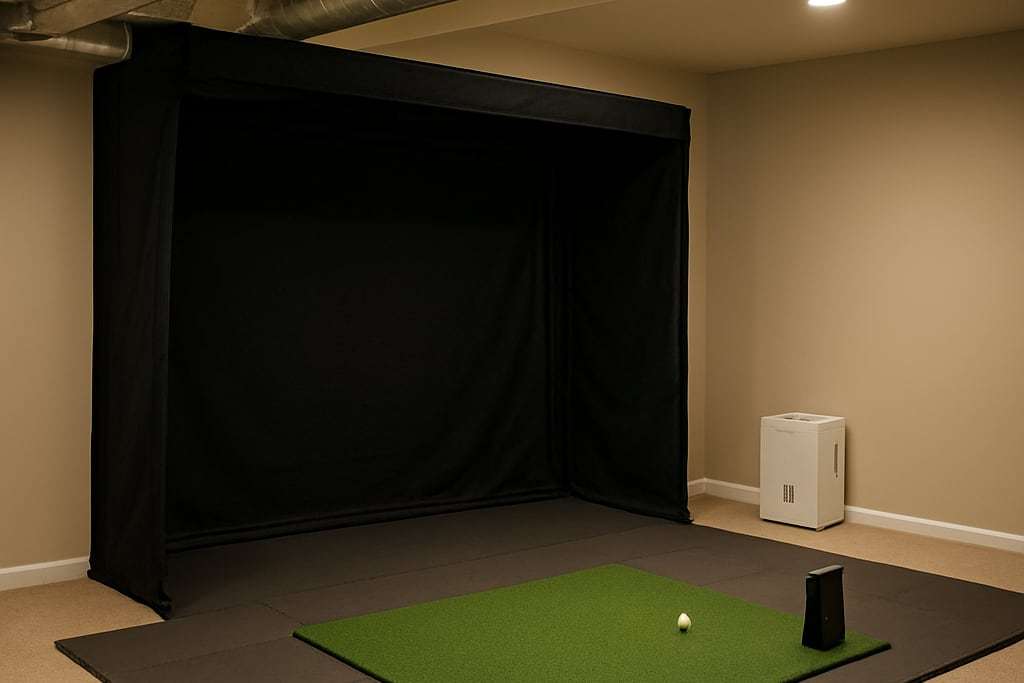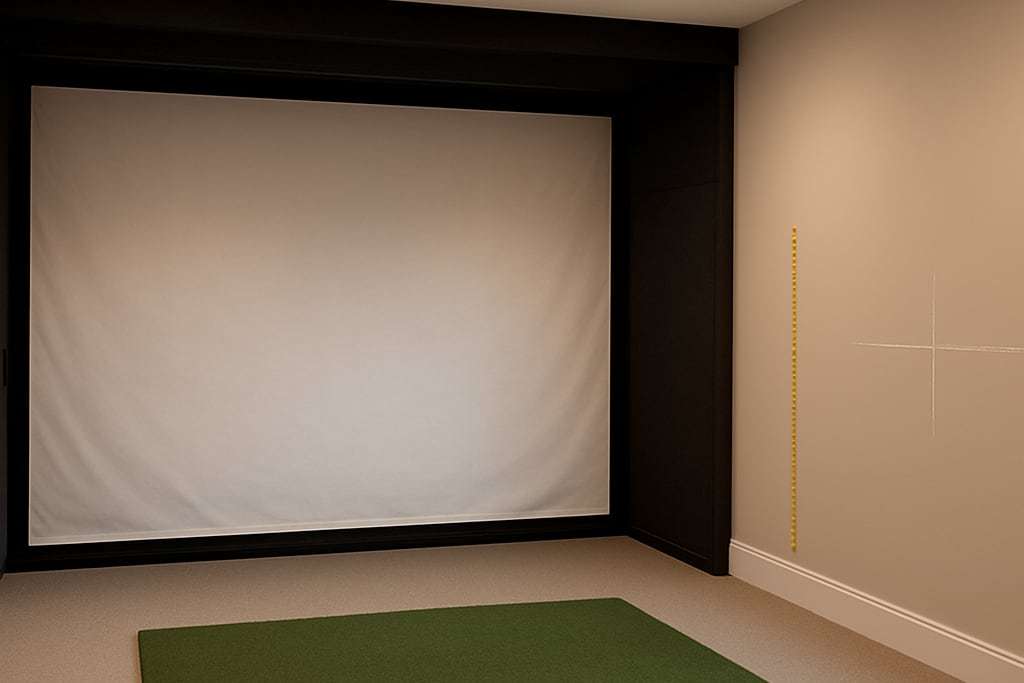
The short answer
Most retailer guides put the floor at 8 to 9 feet and call 10 feet comfortable for a driver. The number that matters is the top of your own swing plus 6 to 9 inches, measured at the spot where you will stand. Mat thickness, lights, ducts and door tracks all take some of that height away.
The dashed circle is the path of the clubhead around the golfer's shoulders. A common rule of thumb is ceiling height of about golfer height plus club length (see the room size calculator), but a real swing is the only test.
The number in a buying guide describes an average golfer, and your swing is not average. A 5 ft 6 in player with a compact swing and a 6 ft 4 in player with a long one can stand in the same room and get opposite answers. This page shows the published ranges, then walks through the one measurement that settles it: your own swing.
The ranges below come from retailer and maker guides. They are guidance, not tests, and they disagree with each other in places. Where they do, both numbers are shown.
The published ranges
Retailers agree on the shape of the answer even when the exact feet differ.
| Source | Minimum | Recommended | Ideal |
|---|---|---|---|
| Shop Indoor Golf | 8 ft 6 in | 9 ft | 10 ft or more |
| Carl’s Place | 8 to 9 ft (shorter clubs) | 10 ft or more | 10 ft or more |
| Rapsodo | about 9 ft for shorter golfers | about 10 ft | 10 to 11 ft for taller golfers |
| Rain or Shine Golf | 9 ft (basic setup) | 10 ft (more comfortable) | not stated |
TruGolf is the strictest. It says an 8 ft ceiling is not recommended for full swings and suits short game and putting only. Sharp, a display maker, says about 8.5 ft is enough for an average-height person, which is the most optimistic figure in the set. If you are close to the bottom of any of these ranges, treat it as a reason to test rather than a green light.
Ceiling height by golfer height
Golfer’s Authority gives a simple table based on how tall the golfer is.
| Golfer height | Ceiling suggested |
|---|---|
| Under 5 ft 6 in | 8.5 to 9 ft |
| 5 ft 6 in to 6 ft | 9 to 10 ft |
| 6 ft to 6 ft 6 in | about 10 ft |
| Over 6 ft 6 in | about 11 ft |
If two people of different heights will share the room, size it for the taller one. Golfer’s Authority suggests 10 to 10.5 ft for a mixed group that includes a 6 ft 5 in player and a 5 ft 8 in player.
Ceiling height by club
The driver is the club that decides. It is the longest club and it swings through the biggest arc.
- Irons and wedges: 8.5 to 9 ft, according to Golfer’s Authority. It says an 8 ft ceiling is irons only.
- Woods and drivers: 10 ft minimum.
- Unrestricted club choice: 10 to 12 ft.
One more warning from Carl’s Place: high-arching wedge shots are the main ceiling-strike risk, not only the backswing. A ball that leaves the face steeply can reach the ceiling before it reaches the screen, so the flight matters as well as the club.
If you can only reach the lower end of these ranges, read the low-ceiling workarounds before you buy anything.
Measure your own swing
Rapsodo and Golfer’s Authority describe the same basic test, and it costs nothing.
- Take your longest club, usually the driver, to the exact spot where the mat will go.
- Stand against a wall or have a helper mark a line, then swing slowly to the top of the backswing. Mark the club tip with chalk or painter’s tape.
- Swing slowly through to the finish and mark the follow-through the same way.
- Measure from the floor to the highest mark.
- Add 6 to 9 inches. That is your minimum ceiling at that spot.
- If a mat will go under your feet, add 2 to 3 inches for its thickness, because that comes off your usable clearance.
Do it more than once, and use several clubs. Golfer’s Authority also recommends a slow-motion test with the driver in the actual room. A slow swing can understate the finish of a fast one, so take the larger 9 inch margin if you swing hard.
Measure the ceiling where you will stand
The ceiling over the hitting spot is the only ceiling that counts. Golfbays advises measuring at the hitting position, not around the edge of the room, and measuring three times.
Then look for the lowest thing in the swing zone, which is often not the ceiling itself:
- light fixtures and recessed cans
- ceiling fans
- ducts, pipes and beams
- garage door tracks and the opener
Carl’s Place makes the same point for basements: map the lowest obstruction, not just the surface. Relocating a ceiling fan or duct can add about one to two weeks to a project, according to Golfer’s Authority, so find these early. Any structural or electrical change is a job for a qualified contractor or electrician, not a guess from a guide.
Sloped ceilings need extra care. Golfer’s Authority says to add 6 to 9 inches to the standard recommendation and measure at the highest point of the swing, not at the low side.
Overhead monitors need height of their own
A launch monitor mounted above you is hung from the ceiling, so it adds a requirement on top of swing clearance. Carl’s Place lists the Uneekor EYE XO at 9 to 10 ft above the hitting surface. The EYE XO starts from $4,999, and a low ceiling can rule it out before you have swung a club.
Monitors that sit beside the ball or behind you do not hang from the ceiling, but Shop Indoor Golf’s room table still lists a 10 ft height for them, so they do not lower the clearance your swing needs. The low-ceiling page covers which ones to consider, and the room-size guide pairs height with width and depth.
What to do with your number
Compare your measured ceiling to the swing you made plus the margin.
- You clear it with room to spare: go ahead. Keep the margin, because forum builders say sim data often makes people swing harder than they planned.
- You clear it only with a shorter club: plan the room for irons and wedges, and treat the driver as a net-only club somewhere else.
- You do not clear it: do not install anything overhead and do not trust padding to cover a strike. Foam on a ceiling softens contact but does not make a rebound or a hit harmless.
Check the basement guide if your room is under a floor above, because joists, ducts and beams are the usual culprits there. If the ceiling is fine but the walls are not, the narrow-room page picks up where this one ends.
Run the numbers
Once you have your swing height, enter it in the room size calculator for a quick pass or fail, and see the low ceiling guide if the answer is tight.
Frequently asked questions
What is the minimum ceiling height for a golf simulator?
Shop Indoor Golf lists 8 ft 6 in as a minimum, 9 ft as recommended and 10 ft or more as ideal. Carl's Place says 8 to 9 ft limits you to shorter clubs and recommends 10 ft or more. Treat these as starting points and measure your own swing.
Can I use a driver with a 9 foot ceiling?
Maybe. Golfer's Authority says a 9 ft ceiling carries a risk of contact with longer clubs and puts woods and drivers at 10 ft minimum. Rapsodo says a golfer about 5 ft 8 in or shorter might be fine at 9 ft. Swing slowly with the real driver in the room before you decide.
Does the hitting mat count against ceiling height?
Yes. Golfer's Authority says to add 2 to 3 inches for mat thickness, so a 9 ft ceiling over a 2 inch mat leaves about 8 ft 10 in of usable clearance. Subtract the mat and any floor padding before you compare against your swing.
How much extra ceiling should I leave above my swing?
Rapsodo and Golfer's Authority both give a rule of thumb of 6 to 9 inches above the highest point of your swing. Leave the larger margin if you swing hard.
How high does an overhead launch monitor need to be?
Carl's Place lists the Uneekor EYE XO at 9 to 10 ft above the hitting surface. Overhead units have their own height requirement on top of the swing clearance, so check the maker's mounting range before you plan the room.