The short answer
An 8 foot ceiling is not a full-swing room. Retailer guides limit it to irons or to short game and putting, and even 9 feet carries a risk of contact with longer clubs. A low room can still work for wedges, putting and a controlled swing if you measure first and pick gear that does not need overhead height.
A low ceiling does not always mean no simulator, but it does mean fewer choices and a stricter honesty test. This page covers what the published guidance says about 8 and 9 foot rooms, which gear works under them and where the answer turns into “pick another room.”
If you have not measured yet, start with how to measure ceiling height from your own swing, then come back.
What the guides say about 8 and 9 feet
The sources agree more than they disagree here.
| Ceiling | What guides say |
|---|---|
| 8 ft | Golfer’s Authority: irons only. TruGolf: not recommended for full swings, suits short game and putting. |
| 8 ft 6 in | Shop Indoor Golf lists it as the minimum. |
| 9 ft | Golfer’s Authority: risk of contact with longer clubs. Rapsodo: may be fine for a golfer about 5 ft 8 in or shorter. |
| 10 ft | Woods and drivers at the minimum, per Golfer’s Authority. |
Carl’s Place states the trade-off plainly: a ceiling of 8 to 9 ft limits you to shorter clubs, and it recommends 10 ft or more. Sharp, a display maker, is the outlier with a claim that about 8.5 ft is enough for an average-height person, but that is one voice against several.
Count the height you really have
A published 9 ft ceiling can hide a few lost inches. The mat takes 2 to 3 inches (Golfer’s Authority), and the lowest fixture, duct or beam over the hitting spot counts, not the ceiling surface. The ceiling-height guide shows how to measure both.
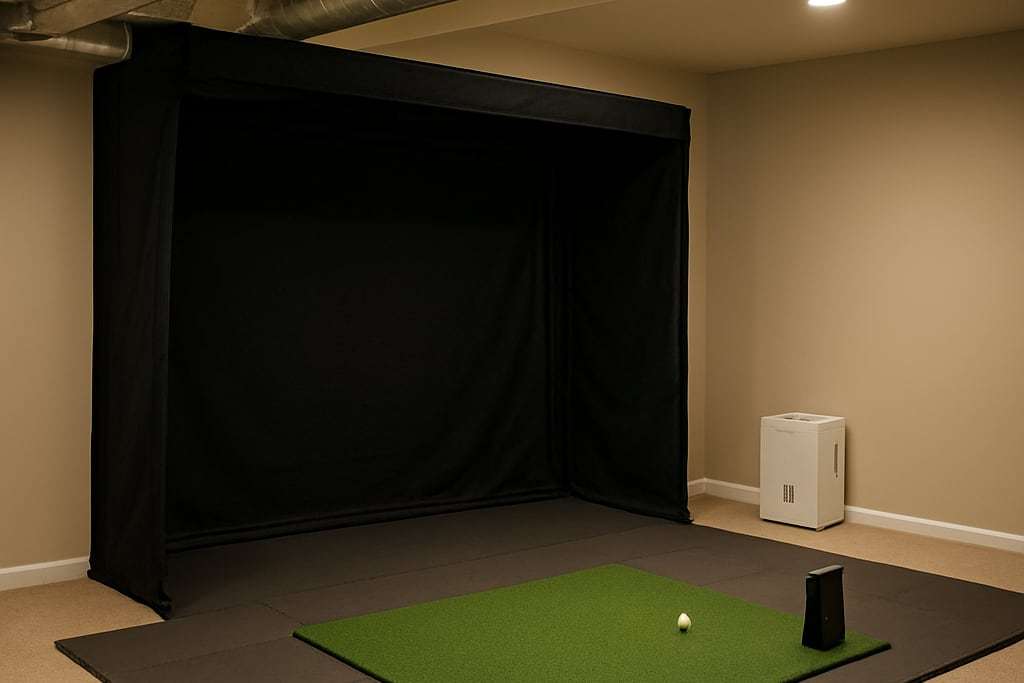
The enclosure frame is the third subtraction. The SIG8 enclosure in the MLM2XPRO package ($2,899.99) has a frame 8 ft 4 in high, so it needs a ceiling clearly above that. A frame nearly as tall as the room leaves no slack for your swing, so check its height against your ceiling before you order.
Gear that does not depend on height
The launch monitor is one place a low room can avoid a problem. Overhead units hang from the ceiling and add their own height requirement, which a low room cannot give. Carl’s Place puts the EYE XO at 9 to 10 ft above the hitting surface, and the Foresight Falcon at 9.5 to 10.5 ft.
Units that sit beside the ball or behind you do not use ceiling space:
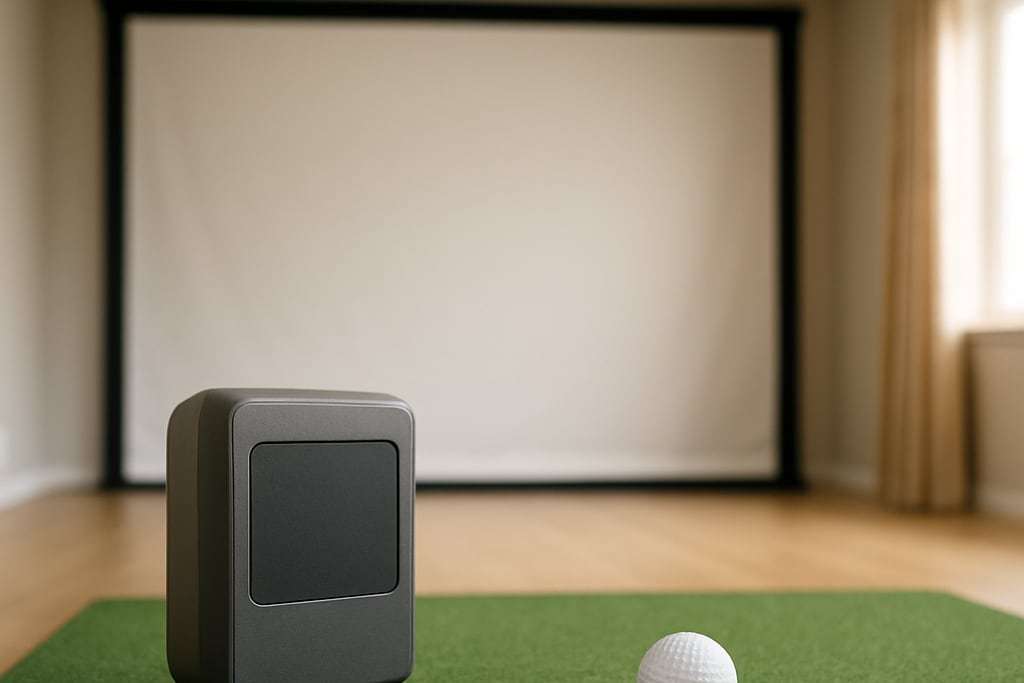
- Beside the ball. The Square Golf Home ($699.99) is a camera unit that sits beside the ball with almost no depth needed behind the golfer. The Uneekor EYE MINI is a camera unit that sits beside the ball, but Shop Indoor Golf’s room table still lists a 10 ft height for it, so a beside-the-ball unit does not lower the ceiling you need.
- Behind the golfer. Radar units such as the Garmin Approach R10 ($499.99) need depth behind the ball rather than a mount overhead. They need a long room, and Shop Indoor Golf’s table lists 10 ft height for them too.
Whichever monitor you pick, your swing clearance is unchanged. The monitor decides whether it fits; your club decides whether you can swing.
Ways to make a low room work
These are workarounds, not guarantees. Each one trades something away.
Use shorter clubs. Irons and wedges clear a lower ceiling than a driver. Set the room up for those and use the driver outdoors.
Take a controlled swing. A three-quarter swing keeps the club tip lower, but it also produces different speed, spin and carry. The numbers you get describe the shorter swing, so use them for practice and wedge distances, not as a full-swing yardage book.
Stand where the ceiling is highest. Ceilings are not always flat. A beam pocket or a raised section can give you inches. Measure at the actual hitting spot, not at the room’s centre or edge.
Keep wedge shots low. Carl’s Place says high-arching wedge shots are the main ceiling-strike risk, so a lower flight keeps the ball further from the ceiling.
Add padding at the ceiling. Carl’s Place says ceiling baffles (vinyl strips) are available, and it points to a Pro enclosure with the hitting area inside it as the best ceiling protection. Padding softens contact; it does not replace clearance, and a forum builder reports being hit by a rebounding ball even with acoustic foam on the ceiling.
Raise the ceiling, if a professional says you can. Moving a ceiling fan or duct can add about one to two weeks to a project, says Golfer’s Authority. Removing drywall, cutting joists or moving ductwork can be structural or involve live wiring, so a qualified contractor or electrician decides, not a guide. The basement guide covers the usual culprits.
When to say no
Some rooms are not worth the money. Walk away, or change the plan, if any of these is true:
- Your full backswing or follow-through touches the ceiling, fixture or ducts in a slow test.
- You want to hit a driver, the ceiling is under 10 ft and a slow driver swing does not clear with margin.
- The room has a low obstruction right over the hitting spot that cannot be moved.
- You would need to hold back your swing every time to avoid a strike.
A net and a launch monitor in a taller space, such as some garages, can beat a low finished room. See the room size guide for the full set of width, depth and height numbers.
A simple decision path
- If the driver clears with the margin, you are in a normal room and can use the standard buying guides.
- If only irons clear, buy for irons: a beside-the-ball or behind-the-golfer monitor, not an overhead one.
- If nothing clears, use the room for putting or pick a different room.
Tell anyone sharing the room where the limit is, keep children and pets out of the swing zone and out of the room while a golfer is hitting, and stop if a shot ever gets close to the ceiling.
Run the numbers
The room size calculator compares your height and longest club with the published ceiling figures, which saves guessing before you test a swing in the room.
Frequently asked questions
Can I put a golf simulator in a room with an 8 foot ceiling?
For a full swing, the guides say no. Golfer's Authority puts an 8 ft ceiling at irons only, and TruGolf says it is not recommended for full swings and suits short game and putting. If you only want wedges, chipping and putting, it can work. Measure your own swing first.
Does a 9 foot ceiling fix the problem?
It helps but does not settle it. Golfer's Authority says 9 ft carries a risk of contact with longer clubs, and puts woods and drivers at 10 ft minimum. A shorter golfer using irons may be fine, which is why a measured swing test matters more than the number on the tape.
Do I need an overhead launch monitor?
No, and in a low room you should avoid one. Carl's Place lists the Uneekor EYE XO at 9 to 10 ft above the hitting surface, so it needs height you may not have. Monitors that sit beside the ball or behind you do not use ceiling space.
Will a three-quarter swing give me accurate numbers?
A shorter swing produces less speed and a different shot, so the data describes that shorter swing, not your full one. That can still be useful for practice and wedge distance work, but it is not a substitute for full-swing numbers outdoors.
Can I raise a low ceiling by taking out drywall?
Some builders talk about opening up the space between joists to gain a few inches. Joists, ducts and wiring can be structural or live, so a qualified contractor or engineer has to decide what can be moved. Do not cut anything on a forum tip.