The short answer
Radar units behind the golfer and overhead cameras do not need to switch sides. Units that sit beside the ball have to move to the other side. The room matters more: a 10 foot wide room works with an offset hitting area, but centering the tee for both hands takes about 14 feet.
Most simulator guides assume one golfer with one stance. A household with a left-hander and a right-hander has a different problem, because everything in the room is built around where the tee sits. Three things decide whether one bay can serve both: the launch monitor’s position, the room’s width and the mat.
Why handedness changes the layout
A right-handed golfer stands with the target on the left and the club swings through a space on the golfer’s right. A left-handed golfer is the mirror image. Anything placed beside the ball, anything placed in the swing arc and the tee position inside the screen all have to work from either stance.
That is why Carl’s Place gives one width for a single offset hitting area and a bigger one for a centered tee that serves both hands. Plan for the harder case first and the easier one comes free.
Monitor placement is the first fork
Launch monitors fall into three placements, and each handles handedness differently.
| Placement | Examples | Left and right handed |
|---|---|---|
| Behind the golfer | Garmin Approach R10 ($499.99), FlightScope Mevo Gen2 (from $1,149), Rapsodo MLM2PRO (from $549.99) | No move needed |
| Beside the ball | Square Golf Home ($699.99), Square Golf Omni ($1,599), Foresight GC3 (from $3,999) | Move the unit to the other side for the other golfer |
| Overhead, in front of the tee | Uneekor EYE XO (from $4,999), ProTee VX (from $6,500) | Fixed, so handedness is not an issue |
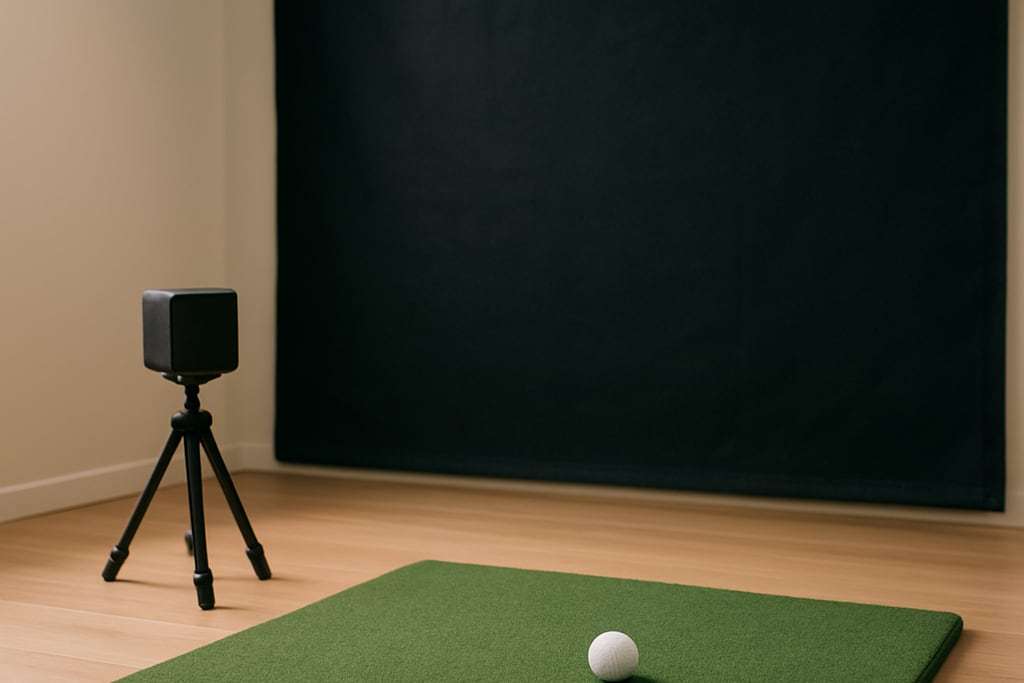
Radar behind the golfer. Golfer’s Authority says radar sits 6 to 8 ft behind the golfer and needs 16 to 21 ft of total depth. Rapsodo’s MLM2PRO is listed at 6.5 to 8.5 ft behind the tee in Carl’s Place’s table. The monitor stays put between players, but the room has to be long. See the radar and camera comparison for the trade-off.
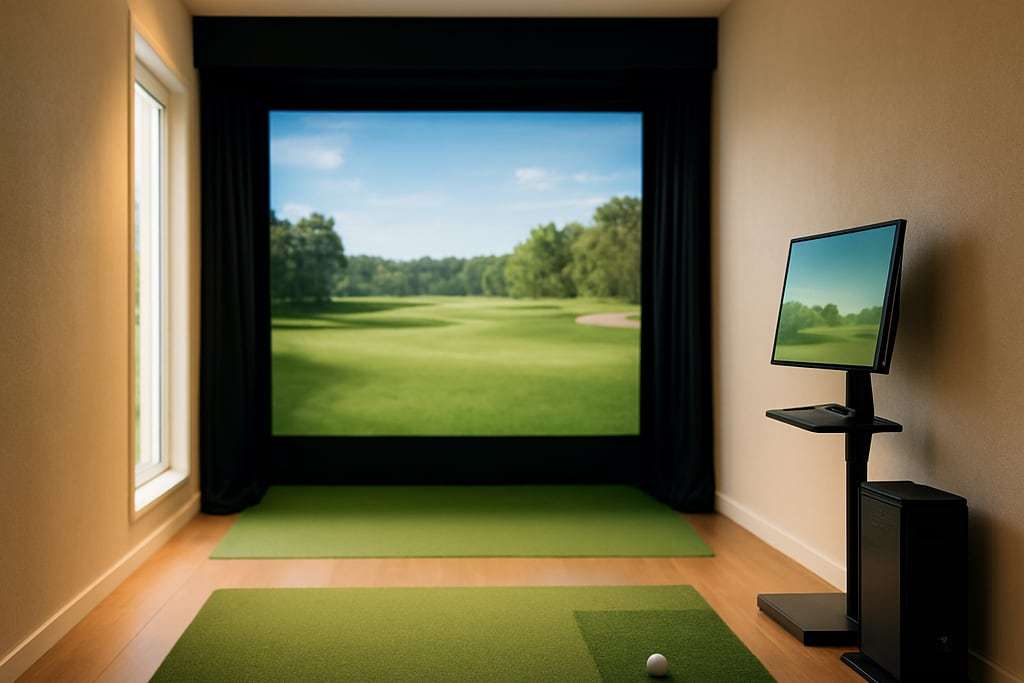
Beside the ball. A PlayBetter review of the Foresight GC3 says it sits to the side and that switching handedness means moving it to the other side. The Square Golf Home and Omni are listed with the same beside-the-ball placement. That is a quick swap if the unit is on a stand with clear floor on both sides, and a chore if it is bolted to a frame.
Overhead. Carl’s Place says the Uneekor EYE XO and XO2 sit about 3.5 ft in front of the tee, 9 to 10 ft up, so the unit does not touch the floor and does not change sides. The same source recommends a 13 ft diameter swing space with the player centered. The price is ceiling height and a higher unit cost.
Room width: the number that decides it
Width is the second fork, and the guides agree on the pattern.
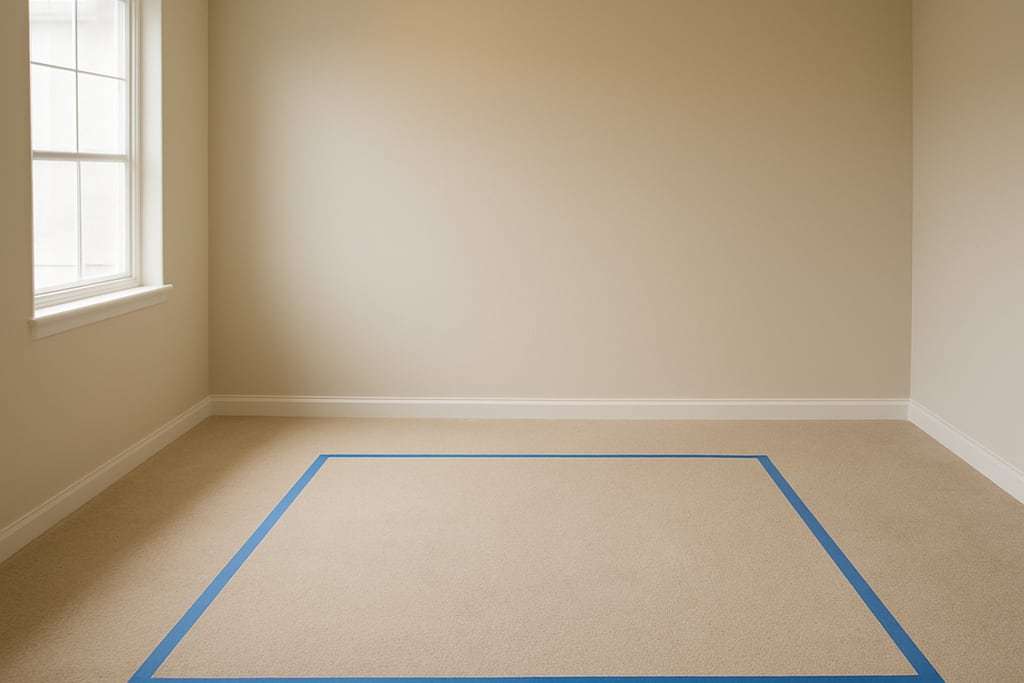
- 10 ft works with an offset hitting area, per Carl’s Place. The tee sits off-centre, which suits one hand better than the other.
- 12 ft is the recommended width in Shop Indoor Golf’s table.
- 14 ft or more is needed to center the hitting area for right- and left-handed golfers, per Carl’s Place, and it is also Shop Indoor Golf’s ideal.
In a 10 ft wide room, an offset tee means one player’s swing arc sits closer to a wall than the other’s. If the room is narrow, the narrow-room guide covers the clearance trade-offs, and the room-size guide lists the full width, depth and height numbers.
Keep the swing circle in mind too. Carl’s Place says to plan for about 7 ft of clearance around the golfer in every direction, and the number is 9 ft for the Garmin R50 and Rapsodo placements in the same table. People, furniture and fixtures should stay outside that circle for both stances.
The screen edges
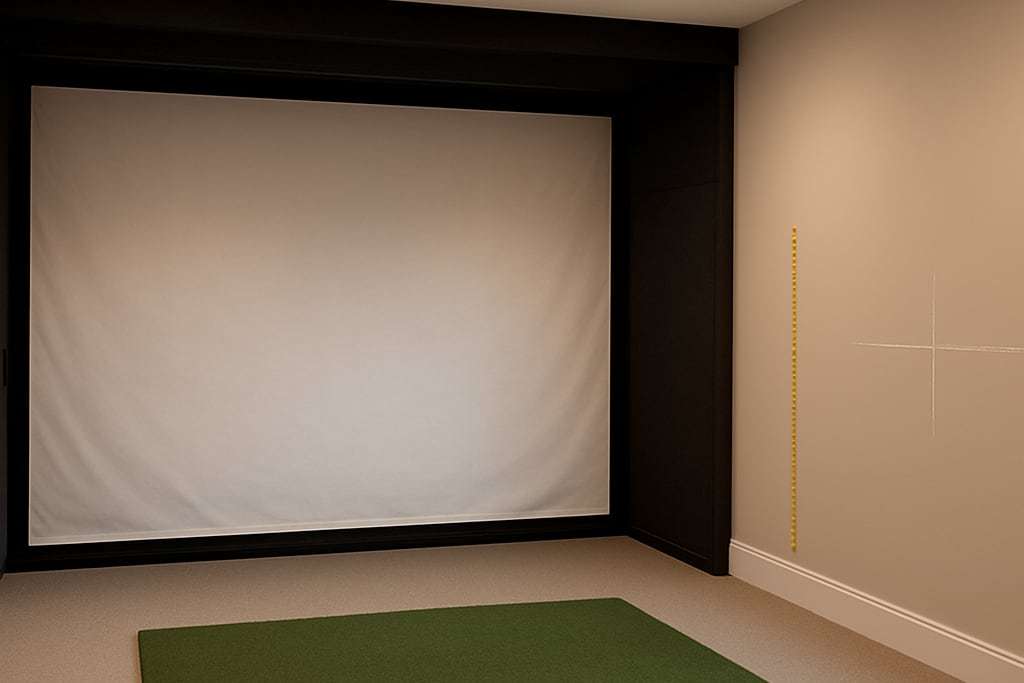
A centered tee puts the golfer in the middle of the screen for both hands. An offset tee puts one hand’s ball flight closer to the screen edge. Netting vendors advise at least 1 ft of buffer behind and to the sides. A forum builder reports that offset hits can pass through the gap where the screen meets the side curtains, so close that seam with padding.
Mat size for two stances
Common mat sizes are 5 ft x 5 ft or 4 ft x 7 ft. Fiberbuilt’s Launch Monitor Studio 4x9 ($1,499) is sold as a center-hitting mat for left and right handed players, which is the one product here built for the job. It is expensive for a mat and has a large footprint.
Side-mounted units add a wrinkle. A PlayBetter review notes that SimStudio packages ship with a 5 ft x 5 ft mat, which may not fit both the GC3 and your feet, and suggests raising the unit to mat height if needed. If the monitor sits at one edge of the mat, the other player has to stand differently or the unit has to move. See the mat guide for more options and joint-strain advice.
Software settings
Whether handedness is a software setting, a hardware move or both depends on the monitor and the program, and the published guides do not say. Before you buy, ask the seller or maker:
- Does the unit report ball and club data correctly for a left-handed golfer without any hardware change?
- Does the software store a separate profile for each player, so you do not reset the setting for every session?
A monitor that sits beside the ball is physically on the wrong side for the other hand, even if the software flips.
Which setup suits a mixed household
- A long room, 14 ft wide or more, with a radar unit. One monitor placement, no swapping. It needs 16 to 21 ft of depth.
- A shorter room, 12 ft wide, with a beside-the-ball camera unit. Plan to move the unit between players, and check the mat size.
- A tall room with an overhead camera. The smoothest for two hands, and the highest unit price of these examples. Read the ceiling-height guide before you buy.
- A tight budget. The budget picks include units from $499.99 that sit behind the golfer, so one placement serves both hands as long as the room is deep enough.
Measure the room with both players swinging, not just the one who is buying. If the left-hander’s finish touches a wall that the right-hander never reaches, you have your answer before you spend anything. Keep children and pets out of the swing zone while anyone is hitting.
Run the numbers
Test both hands in the room size calculator by entering the width you can offer on each side of the tee.
Frequently asked questions
How wide must the room be for left and right handed golfers?
Carl's Place says 10 ft wide works with an offset hitting area, but about 14 ft or more is needed to center the hitting area for right- and left-handed golfers. Shop Indoor Golf's table lists 12 ft recommended and 14 ft or more ideal.
Does a radar launch monitor work for both hands?
The unit sits behind the golfer, so it does not need to move to the other side. The cost is depth: Golfer's Authority puts radar rooms at 16 to 21 ft deep. Whether the software has a left-handed setting is a question for the maker.
Do side-mounted camera monitors need to be moved for a left-handed golfer?
Yes. A PlayBetter review of the Foresight GC3 says it sits to the side and that switching handedness means moving it to the other side. The same logic applies to any unit that sits beside the ball.
Is an overhead launch monitor better for mixed hands?
It avoids the swap because the unit is fixed above and in front of the tee, so handedness is not an issue. It needs a high ceiling, though: Carl's Place lists the Uneekor EYE XO at 9 to 10 ft above the hitting surface.
Do I need two mats?
Not necessarily. Fiberbuilt's Launch Monitor Studio 4x9 ($1,499) is sold as a center-hitting mat for left and right handed players. Cheaper 5 ft x 5 ft or 4 ft x 7 ft mats are common sizes, but check that a side-mounted unit does not collide with your feet.
Sources
- Carl's Place: Measuring your space for an indoor golf simulator
- Shop Indoor Golf: How much space do you need for a golf simulator
- Golfer's Authority: Photometric vs radar launch monitor
- PlayBetter: Foresight GC3 home golf simulator space requirements
- Square Golf Home at Rain or Shine Golf
- Fiberbuilt Launch Monitor Studio 4x9 at Rain or Shine Golf