The short answer
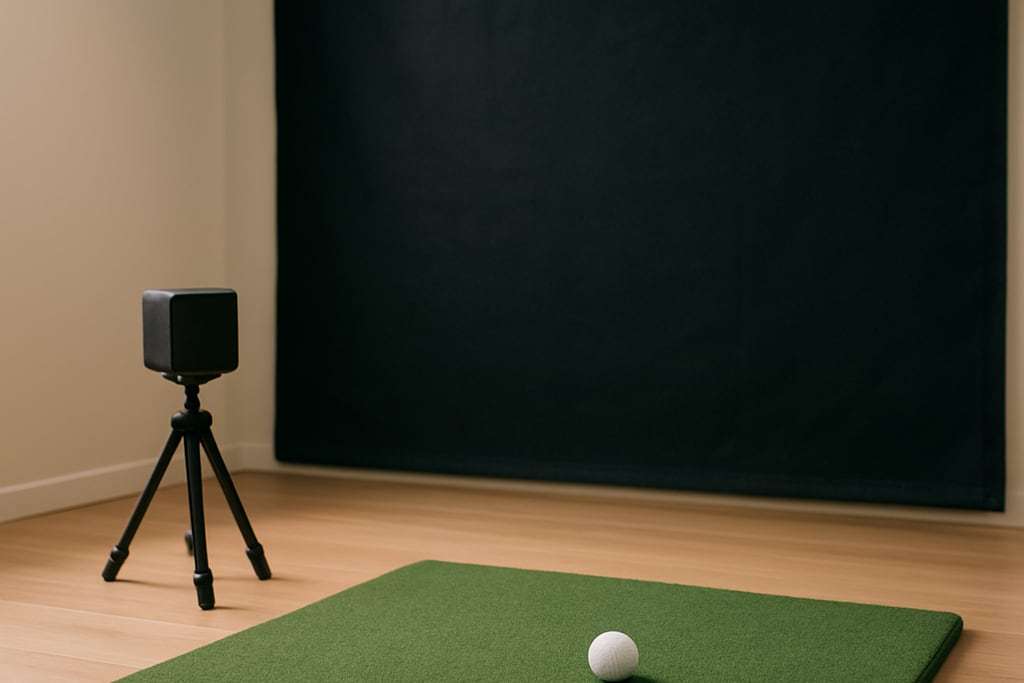
For a room that is short on depth, start with the Square Golf Home at $699.99. It is a camera unit that sits beside the ball and needs almost no depth behind the golfer, which is the main limit in a bedroom or office. If you want a projected image too, pair a camera monitor with the BenQ AH30ST short-throw projector at $1,499.
We earn a commission when you buy through some links on this site, at no extra cost to you. It never changes what we recommend.
Left-handed golfers mirror the layout. If you hit from off-centre, each side still needs room for the swing: check the nearer wall first.
Our picks
Square Golf Home
Launch monitor (camera)
$699.99. High-speed camera with machine vision that sits beside the ball, with almost no depth needed behind the golfer.
- TechnologyHigh-speed camera with machine vision
- SoftwareNo annual fee; pay-per-round tokens for Square's course library
- PlacementSits beside the ball; almost no depth needed behind the golfer
Listed price$699.99
Check price at Rain or Shine GolfSpecs & trade-offs
Club stickers and dotted balls are included; rounds on Square's library use paid tokens.
- Technology
- High-speed camera with machine vision
- Placement
- Sits beside the ball; almost no depth needed behind the golfer
- Measured data
- Spin rate, spin axis, swing path, face angle, dynamic loft, angle of attack
- Stickers and balls
- Club stickers and dotted balls included
- Software
- No annual fee; pay-per-round tokens for Square's course library
- Suits tight rooms
- Spin and club data are measured, not estimated
- Club data needs club stickers
- Playing rounds on Square's library uses paid tokens
- Needs a stand or placement beside the ball
Omni
Launch monitor (camera)
$1,599. Four high-speed cameras beside the ball, working with any standard ball indoors and outdoors.
- TechnologyFour high-speed cameras
- UseIndoor and outdoor
- BallsWorks with any standard ball
Listed price$1,599
Check price at Rain or Shine GolfSpecs & trade-offs
Rounds use Square's paid tokens or third-party software.
- Technology
- Four high-speed cameras
- Use
- Indoor and outdoor
- Balls
- Works with any standard ball
- Placement
- Beside the ball
- No marked balls
- Handles indoor and outdoor
- Round play uses Square's paid tokens or third-party software
- Newer to the market than Foresight or Uneekor
- Needs a stand or placement
EYE MINI CORE
Launch monitor (camera)
From $1,199. Compact camera unit with minimal setup and 1 year of GSPro included.
- TechnologyHigh-speed cameras and infrared
- SoftwareIncludes 1 year of GSPro
- SetupMinimal setup; compact design
Listed pricefrom $1,199
Check price at Carl's PlaceSpecs & trade-offs
Shop Indoor Golf lists the EYE MINI line as beside-the-ball units. GSPro needs a renewal after the first year, and you need a PC.
- Technology
- High-speed cameras and infrared
- Software
- Includes 1 year of GSPro
- Setup
- Minimal setup; compact design
- Compatibility
- Works with top simulation software
- Lowest-priced Uneekor listed
- Includes a year of GSPro
- GSPro needs a renewal after the first year
- Needs a PC
- Fewer features than the MINI and MINI LITE
ST Max
Launch monitor (radar + camera)
From $1,695. Dual Doppler radar plus photometric cameras, listed by Shop Indoor Golf as a beside-the-ball unit, with Speed Training powered by GOLFTEC built in.
- TechnologyDual Doppler radar plus photometric cameras
- SoftwareGame Improvement suite; pairs with E6, GSPro and SkyTrak software
- TrainingSpeed Training powered by GOLFTEC built in
Listed pricefrom $1,695
Check price at Carl's PlaceSpecs & trade-offs
Course packs and software tiers cost extra.
- Technology
- Dual Doppler radar plus photometric cameras
- Training
- Speed Training powered by GOLFTEC built in
- Software
- Game Improvement suite; pairs with E6, GSPro and SkyTrak software
- Design
- Modular internal build, charcoal finish
- Directly measures ball flight and club delivery
- Practice and speed-training tools included
- Course play packs cost extra
- Software tiers add cost
- Needs a stand or placement beside the ball
AH30ST
Projector
$1,499. A short-throw projector with Golf Mode and auto keystone that helps avoid shadows.
- ThrowShort throw
- ModeGolf Mode picture preset
- SetupAuto keystone
Listed price$1,499
Check price at Carl's PlaceSpecs & trade-offs
It is not 4K, the mount is sold separately and brightness should be checked against your room light.
- Throw
- Short throw
- Mode
- Golf Mode picture preset
- Setup
- Auto keystone
- Short throw helps avoid shadows
- Golf Mode
- Not 4K
- Check brightness against your room light
- Mount sold separately
Square Omni SIG DIY Golf Simulator Studio Package
Simulator package
From $2,899.98 with a Square Omni, an SIG DIY enclosure in several sizes and an SIGPRO Premium screen.
- Launch monitorSquare Omni
- EnclosureSIG DIY, multiple sizes
- ScreenSIGPRO Premium impact screen
Listed pricefrom $2,899.98
Check price at Shop Indoor GolfSpecs & trade-offs
The projector and mat may be extra, and you assemble the frame.
- Launch monitor
- Square Omni
- Enclosure
- SIG DIY, multiple sizes
- Screen
- SIGPRO Premium impact screen
- Fittings
- Connectors and instructions included
- Compact setup
- Camera-based tracking
- Projector and mat may be extra
- Square tokens or third-party software for rounds
- DIY frame assembly
| Model | Best for | Type | Listed price |
|---|---|---|---|
| Square Golf Home | Best for the shortest room | Launch monitor (camera) | $699.99 |
| Omni | Best camera unit that uses any ball | Launch monitor (camera) | $1,599 |
| EYE MINI CORE | Best compact camera unit with software included | Launch monitor (camera) | from $1,199 |
| ST Max | Beside-the-ball unit with training tools | Launch monitor (radar + camera) | from $1,695 |
| AH30ST | Best short-throw projector for a short room | Projector | $1,499 |
| Square Omni SIG DIY Golf Simulator Studio Package | Best compact enclosure package | Simulator package | from $2,899.98 |
A small room gives you three limits at once: depth, width and ceiling height. Depth is the easiest to work around, because the right monitor can shrink it. The picks above favour units that sit beside the ball and a short-throw projector. They are described from retailer pages and published specifications, not from using them in a spare room. If the room is narrow rather than short, the narrow room guide goes further.
What a small room can and cannot do
Retailer guides put the floor near 10 feet wide, 15 feet deep and 8.5 to 9 feet high. Under that, you are making a compromise: shorter clubs, one handedness or a smaller screen. TruGolf lists 8 foot ceilings as suitable for short game and putting only.
| Limit | Common retailer guidance | If your room falls short |
|---|---|---|
| Depth | 15 ft minimum, 18 ft comfortable | Camera unit beside the ball, smaller screen |
| Width | 10 ft minimum with an offset tee, 14 ft for both hands | Set up for one hand |
| Height | 8.5 to 9 ft minimum, 10 ft for drivers | Irons only |
Depth breaks down in a simple way: about 1 foot behind the screen, 10 feet from the screen to the ball and 4 feet behind the golfer makes 15 feet, per Carl’s Place. The more comfortable layout uses 10 to 12 feet to the ball and about 7 feet behind the tee, which is 18 to 20 feet in total.
Why the monitor type matters most
Radar needs depth: roughly 6 to 8 feet behind the golfer and about 8 feet of ball flight in front, so the retailer figures run 16 to 21 feet. A 12 foot room is the wrong place for it. Camera units that sit beside the ball need about 10 feet of depth by Golfer’s Authority’s figures for a solo setup, or 15 to 16 feet of room in Shop Indoor Golf’s table. That is why the Square Golf Home, the Square Omni, the Uneekor EYE MINI CORE and the SkyTrak ST Max are on this page.
The trade-offs are real. Camera units want steady lighting and more care with lenses and stickers, and switching handedness means moving the unit to the other side. The radar versus camera page lays this out, and the launch monitor guide ranks the options by price.
Projector or no projector
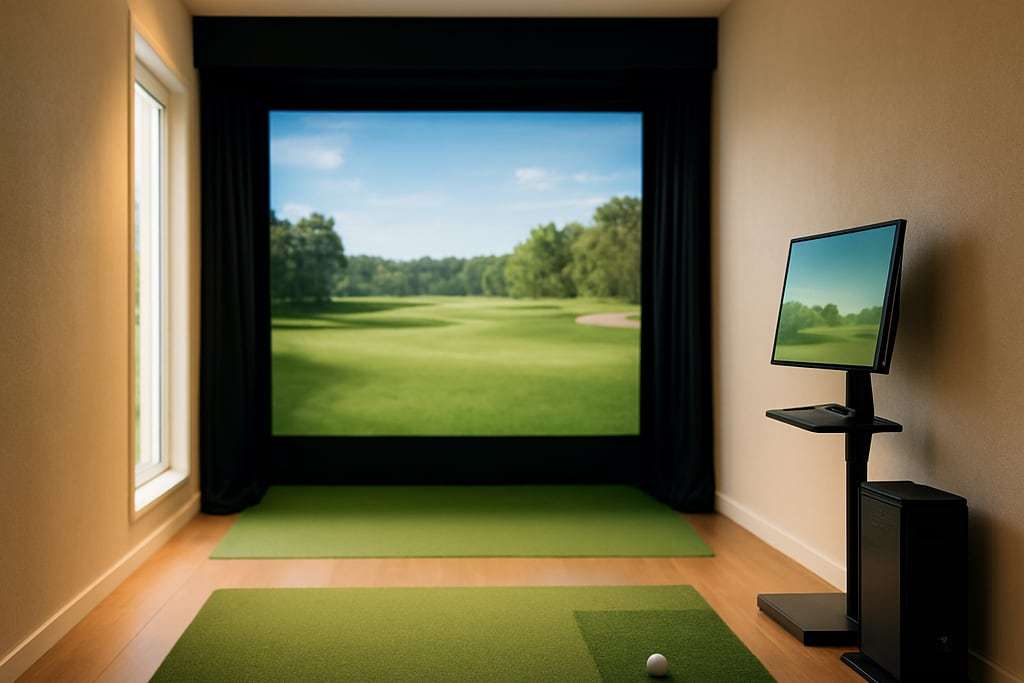
A short-throw projector can sit within about 10 feet of the screen, while a standard-throw model needs more distance. The BenQ AH30ST is a short-throw model with Golf Mode and auto keystone, and it is $1,499 before a mount. Mount the projector out of the line of fire; BenQ suggests the target line 7 to 8 feet from the screen, and in a room with a low ceiling the tilt and keystone correction need care.
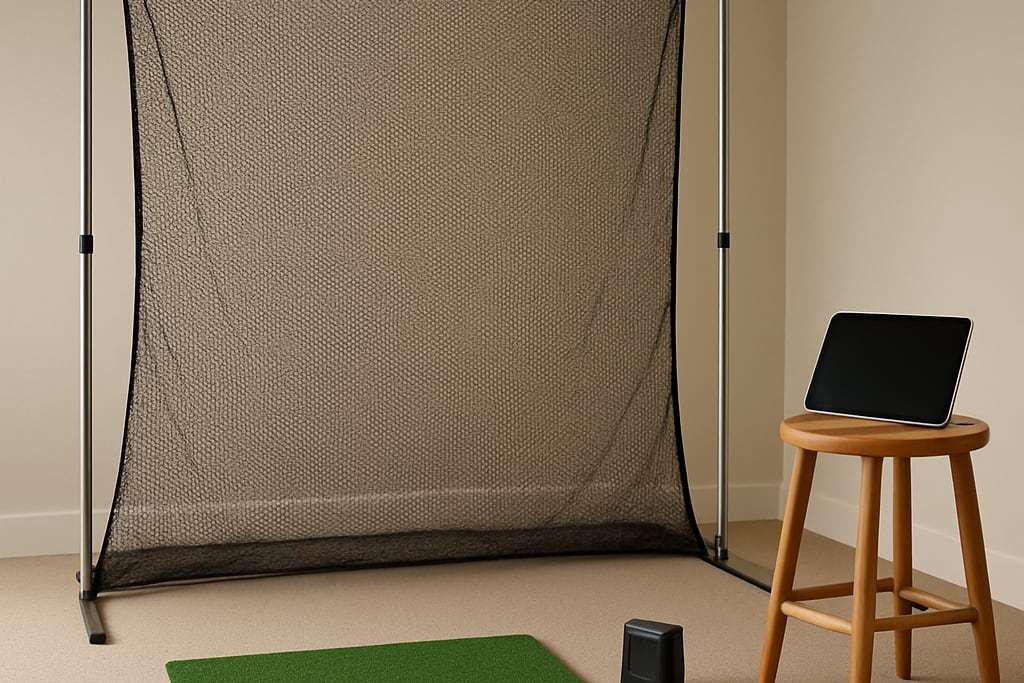
If the budget or the room is tight, skip the projector. A net with a TV or monitor costs less, though you give up the projected course.
Compact enclosures and nets
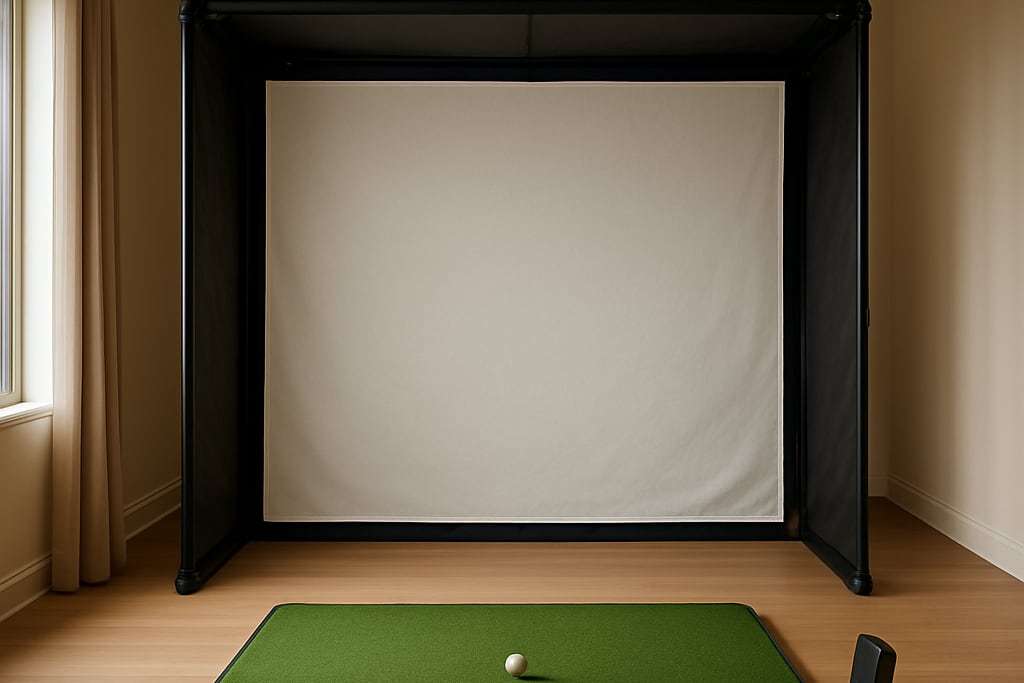
Shop Indoor Golf’s SIG8 enclosure frame is 8 feet 4 inches wide, made for rooms under 9 feet wide. Rain or Shine Golf’s simDIY kit comes in 8x10.5 and 9x12. Enclosures should keep at least 6 inches of buffer each side, and the screen should sit 12 to 16 inches from the wall. A net is smaller and portable, but it needs about 1 foot of clear space behind and beside it.
Lay the room out on paper first
Before you buy, sketch the room as a top view and place four things: the screen, the tee, the monitor and the projector. Start from the back wall. Leave 12 to 16 inches behind the screen, put the tee 10 to 12 feet in front of it if the room allows, and leave about 7 feet behind the tee.
If the room is only 12 feet deep, Carl’s Place’s formula leaves about 7 feet from screen to ball (12 minus 1 behind the screen minus 4 behind the golfer). That is under the 8 to 10 feet TruGolf suggests, and Golfer’s Authority reports SkyTrak saying that under 8 feet can hurt mechanics and data. In a room that short, check the monitor’s own placement rule and choose a smaller screen.
Next mark the swing circle of about 7 feet around the tee and move everything breakable out of it. Then count the outlets and plan the cables, and have an electrician confirm circuit capacity and surge protection if the room shares a circuit.
Making the room do two jobs
Many small rooms are also guest rooms or offices. A retractable screen or a portable net lets you clear the floor. The Vanish LITE from Rain or Shine Golf, from $2,299.99, is a semi-retractable enclosure that works with sloped or vaulted ceilings, but wall or ceiling anchoring needs care. Keep the monitor, the laptop and the balls somewhere easy to reach, so setting up stays quick.
Sound and safety in a spare room
Distance helps reduce bounce-back, and a small room has less of it. Keep the screen taut, add padding at the frame edges, and cover hard objects. Keep the swing circle of about 7 feet clear of people, pets and furniture. Measure your own swing; no setup is risk-free. Any new outlet or circuit is for a qualified electrician.
Run the numbers
The room size calculator gives a pass, tight or short result for your room, and the cost calculator shows what the compact build costs once software is included.
Who should skip a small-room build
Skip it if the ceiling is under about 9 feet and you want to swing a driver, if the room is under about 10 feet wide and you cannot rearrange the furniture, or if the room is a shared bedroom where noise is a problem. In those cases a practice net in a garage may fit better, and the garage guide shows how.
Buying mistakes
- Buying radar for a short room.
- Choosing a screen wider than the room.
- Forgetting the projector’s mount line.
- Assuming one monitor suits both hands. A beside-the-ball unit moves to the other side.
- Ordering a bundle first. Use the package guide after you have measured.
Frequently asked questions
What is the smallest room that works?
Shop Indoor Golf's table gives 10 feet wide, 15 feet deep and 8 feet 6 inches high as the minimum. TruGolf lists 10 by 12 by 9 for its Starter 10. Both are retailer figures, so measure your swing in the room.
Which launch monitor type suits a short room?
Camera units that sit beside the ball need the least depth. Radar units need about 16 to 21 feet of depth in the retailer figures, so they are a poor fit for a short room.
How close can a projector sit to the screen?
A short-throw model can sit within about 10 feet. Throw distance is the throw ratio times the screen width, so a 0.8 ratio and a 10 foot wide image means mounting 8 feet away. Check the ratio on the spec sheet of the projector you pick.
How wide a screen fits a narrow room?
Golfer's Authority says screens 10 to 12 feet wide need at least 12 feet of room width, which includes 1 foot of buffer each side. In a narrower room, choose a smaller screen: the SIG8 frame is 8 feet 4 inches wide and is made for rooms under 9 feet wide.
Can a small room do two jobs?
Yes, if the setup clears away. A portable net or a semi-retractable screen such as the Vanish LITE from $2,299.99 gives the floor back, but wall or ceiling anchoring needs care.
Sources
- Shop Indoor Golf: how much space a golf simulator needs
- Golfer's Authority: photometric vs radar launch monitors
- Golfer's Authority: golf simulator space requirements
- Carl's Place: measuring your space for an indoor golf simulator
- TruGolf: golf simulator room dimensions
- PlayBetter: how to choose a golf simulator projector