The short answer
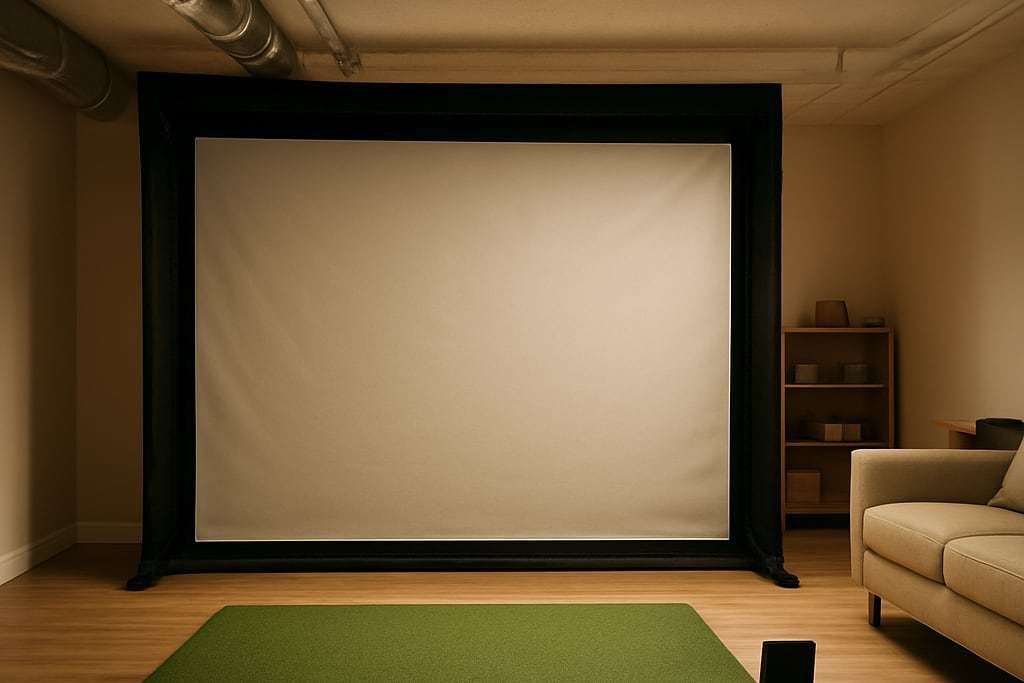
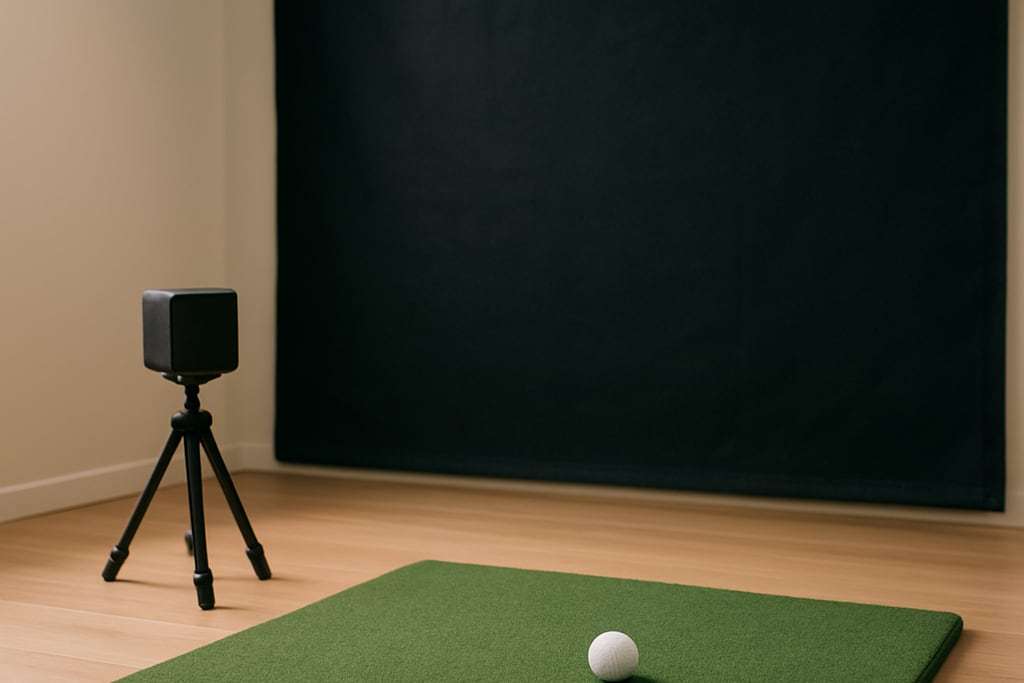
For most finished basements, start with the Uneekor EYE MINI CORE from $1,199: a compact camera unit from a line Shop Indoor Golf lists as beside-the-ball, so no ceiling mount, and it includes 1 year of GSPro. For a short or narrow space, the Square Golf Home at $699.99 needs almost no depth behind the golfer. Measure the lowest beam or duct before you buy anything.
We earn a commission when you buy through some links on this site, at no extra cost to you. It never changes what we recommend.
The dashed circle is the path of the clubhead around the golfer's shoulders. A common rule of thumb is ceiling height of about golfer height plus club length (see the room size calculator), but a real swing is the only test.
Our picks
EYE MINI CORE
Launch monitor (camera)
From $1,199. High-speed cameras with infrared, compact and quick to set up, with 1 year of GSPro included.
- TechnologyHigh-speed cameras and infrared
- SoftwareIncludes 1 year of GSPro
- SetupMinimal setup; compact design
Listed pricefrom $1,199
Check price at Carl's PlaceSpecs & trade-offs
It needs a PC and a GSPro renewal after the first year.
- Technology
- High-speed cameras and infrared
- Software
- Includes 1 year of GSPro
- Setup
- Minimal setup; compact design
- Compatibility
- Works with top simulation software
- Lowest-priced Uneekor listed
- Includes a year of GSPro
- GSPro needs a renewal after the first year
- Needs a PC
- Fewer features than the MINI and MINI LITE
EYE MINI LITE
Launch monitor (camera)
From $1,699. Photometric cameras for indoor use, set up by plugging in power and Ethernet and aiming at the screen.
- TechnologyPhotometric cameras
- ConnectionEthernet only, not Wi-Fi
- UseIndoor use
Listed pricefrom $1,699
Check price at Carl's PlaceSpecs & trade-offs
It is Ethernet only, with no Wi-Fi, and Uneekor software tiers cost extra.
- Technology
- Photometric cameras
- Connection
- Ethernet only, not Wi-Fi
- Use
- Indoor use
- Setup
- Plug in power and Ethernet, aim at the screen
- Easy to set up
- Camera-based direct measurement
- Needs a wired network run to the hitting station
- Uneekor software tiers cost extra
- Indoor-focused
Square Golf Home
Launch monitor (camera)
$699.99 camera unit beside the ball with almost no depth needed behind the golfer.
- TechnologyHigh-speed camera with machine vision
- SoftwareNo annual fee; pay-per-round tokens for Square's course library
- PlacementSits beside the ball; almost no depth needed behind the golfer
Listed price$699.99
Check price at Rain or Shine GolfSpecs & trade-offs
Club stickers and dotted balls are included, and rounds on Square's library use paid tokens.
- Technology
- High-speed camera with machine vision
- Placement
- Sits beside the ball; almost no depth needed behind the golfer
- Measured data
- Spin rate, spin axis, swing path, face angle, dynamic loft, angle of attack
- Stickers and balls
- Club stickers and dotted balls included
- Software
- No annual fee; pay-per-round tokens for Square's course library
- Suits tight rooms
- Spin and club data are measured, not estimated
- Club data needs club stickers
- Playing rounds on Square's library uses paid tokens
- Needs a stand or placement beside the ball
MLM2XPRO SIG8 Golf Simulator Package
Simulator package
$2,899.99 with a Rapsodo MLM2XPRO, an SIG8 enclosure, an SIGPRO Premium screen and a mat, made for rooms under 9 feet wide.
- RoomMade for rooms under 9 feet wide; plan depth behind the mat
- Launch monitorRapsodo MLM2XPRO
- EnclosureSIG8, frame 8'4" wide by 8'4" high
Listed price$2,899.99
Check price at Shop Indoor GolfSpecs & trade-offs
Plan extra depth behind the mat; course play needs a Core membership after the trial.
- Launch monitor
- Rapsodo MLM2XPRO
- Enclosure
- SIG8, frame 8'4" wide by 8'4" high
- Screen
- SIGPRO Premium, 7'7" x 7'7" viewable
- Mat
- Fairway Series 5x5 or SIGPRO Softy
- Projector
- Bundled by default, can be swapped or removed
- Room
- Made for rooms under 9 feet wide; plan depth behind the mat
- Complete studio around a sub-$1,000 monitor
- Putting supported
- Course play needs a Core membership after the trial
- Plan extra depth behind the mat
- Needs a PC or tablet
EYE MINI CORE Golf Package
Simulator package
From $4,499.95 with an Uneekor EYE MINI CORE, Carl's DIY enclosure and premium screen, a BenQ AH30ST projector and a HotShot 4x9 mat.
- Launch monitorUneekor EYE MINI CORE
- EnclosureCarl's DIY golf enclosure, choice of size
- ScreenPremium impact screen
Listed pricefrom $4,499.95
Check price at Carl's PlaceSpecs & trade-offs
It needs a PC and enough width and ceiling height.
- Launch monitor
- Uneekor EYE MINI CORE
- Enclosure
- Carl's DIY golf enclosure, choice of size
- Screen
- Premium impact screen
- Projector
- BenQ AH30ST
- Mat
- HotShot 4x9
- Everything in one order
- Carl's own enclosure
- Price rises with larger enclosure sizes
- Needs a PC for GSPro
- Needs enough room width and ceiling height
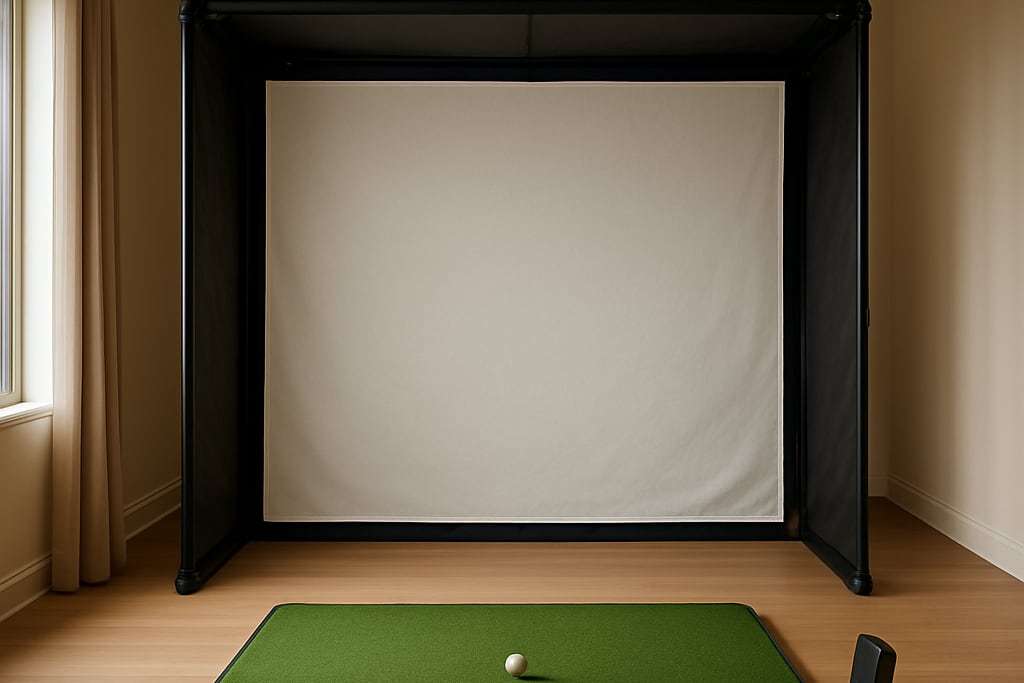
DIY Golf Enclosure Kit with Impact Screen
Enclosure
From $999.95 for a BlackStop fabric enclosure with an impact screen to the floor.
- MaterialBlackStop fabric enclosure
- ScreenImpact screen that runs to the floor
- FrameFittings included; pipe sold separately or as a Pipe Framing Kit
Listed pricefrom $999.95
Check price at Carl's PlaceSpecs & trade-offs
You build the frame, and the pipe is sold separately.
- Material
- BlackStop fabric enclosure
- Screen
- Impact screen that runs to the floor
- Frame
- Fittings included; pipe sold separately or as a Pipe Framing Kit
- Lowest-priced Carl's enclosure kit
- Screen runs to the floor
- You build the frame
- Price rises with size
- Needs space for the full width and depth
| Model | Best for | Type | Listed price |
|---|---|---|---|
| EYE MINI CORE | Best starting point for a finished basement | Launch monitor (camera) | from $1,199 |
| EYE MINI LITE | Best when you can run a network cable | Launch monitor (camera) | from $1,699 |
| Square Golf Home | Best for tight depth | Launch monitor (camera) | $699.99 |
| MLM2XPRO SIG8 Golf Simulator Package | Best complete studio for a narrow basement room | Simulator package | $2,899.99 |
| EYE MINI CORE Golf Package | Best all-in-one for a dedicated room | Simulator package | from $4,499.95 |
| DIY Golf Enclosure Kit with Impact Screen | Lowest-priced enclosure kit with a screen | Enclosure | from $999.95 |
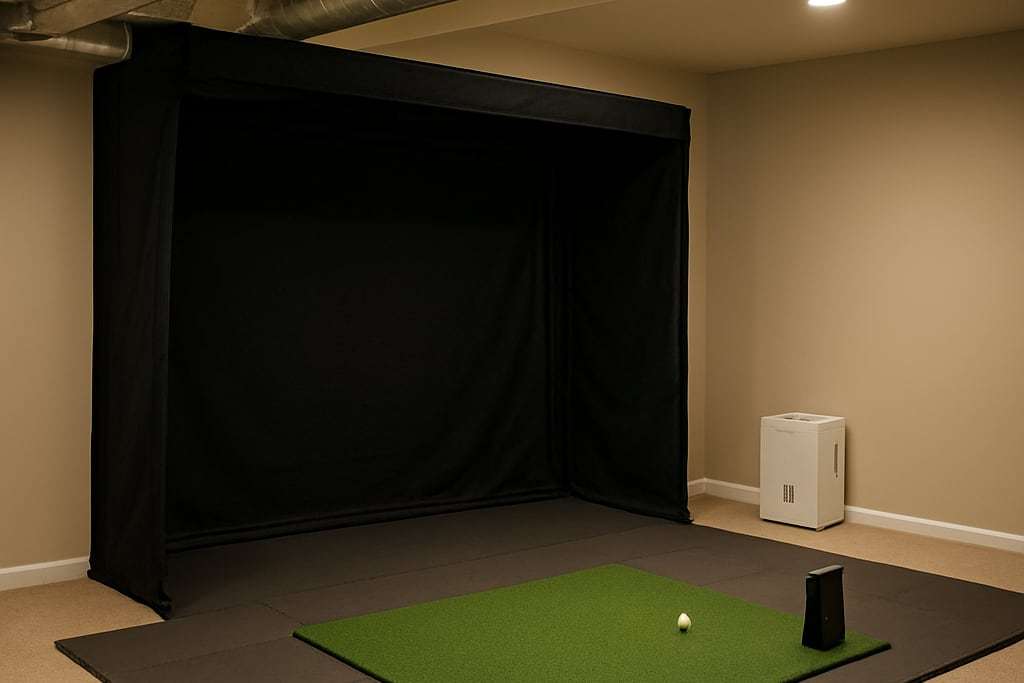
A basement has real advantages for a simulator. It is already enclosed, which helps with noise, and a darker room gives a cleaner projected image. It also has real problems: low beams, ducts, damp air and a hard slab. The picks above are chosen to work around those, and they come from retailer pages and published specifications, not from installing or using them. If your ceiling is at or under 8 feet, read the low ceiling guide before you spend anything.
Find the lowest thing in the swing zone
Measure the ceiling at the spot where you will swing, not at the walls. Then look up for the lowest obstruction: beams, joist pockets, ducts, pipes, wiring and light fixtures. Carl’s Place says to map these early because they intrude on the swing path or the projector line.
Golfer’s Authority suggests an ordinary range by height:
| Golfer height | Suggested ceiling |
|---|---|
| Under 5 ft 6 in | 8.5 to 9 ft |
| 5 ft 6 in to 6 ft | 9 to 10 ft |
| 6 ft to 6.5 ft | About 10 ft |
It also says an 8 foot ceiling suits irons only and woods and drivers want 10 feet. Subtract 2 to 3 inches for the mat. The rule of thumb from Rapsodo and Golfer’s Authority is to leave 6 to 9 inches above the top of your swing. Take a driver, make slow practice swings in the real spot and see what you clear. The low ceiling guide covers three-quarter swings and when to say no.
Pick a monitor that does not need the ceiling
An overhead monitor mounts 9 to 10 feet above the hitting surface: Carl’s Place lists the Uneekor EYE XO at 9 to 10 feet and the Foresight Falcon at 9.5 to 10.5, and many finished basements do not have that. A unit that sits beside the ball avoids that. In Shop Indoor Golf’s table, camera units beside the ball need about 10 feet of height and 15 to 16 feet of depth, and the table lists the Uneekor EYE MINI line among them. The Square Golf Home also sits beside the ball. A radar unit behind the golfer needs about 16 to 19 feet of depth, which many basements cannot give. The radar versus camera page explains why.
Moisture, dust and the cold slab
Basements hold more moisture than the rest of the house. Run a dehumidifier to protect the turf, the screen, the electronics and the projector, and keep air moving to prevent mold. If the basement is unfinished, concrete dust settles on electronics, so seal the slab or finish the flooring first.
The slab is cold and hard. Add a subfloor, foam tiles or padding, and cut a recess so the mat sits flush. Carl’s lists a floor tile system from $59.95 and hitting strips from $79.95 as starting points. The flooring guide shows how to layer them.
Gaining height, and when not to
Some guides say opening the ceiling between the joists gains roughly 4 to 6 inches. Treat that as a warning, not a method: joists carry the floor above, and a qualified contractor or engineer should decide what can be cut, moved or boxed in. Relocating a duct is a more modest job, but it can still add 1 to 2 weeks.
If the numbers do not work, change the plan instead of the house. Hit shorter clubs only, use a monitor that sits beside the ball, keep the swing three-quarter, or move the hitting spot to where the lowest obstruction is highest.
A basement layout checklist
Before you order, draw the room to scale and check these:
- Hitting spot: highest ceiling point, away from ducts and fixtures.
- Screen position: 12 to 16 inches off the wall, with 10 to 12 feet from the ball and about 7 feet behind the tee.
- Width: 10 feet is the minimum with an offset hitting area, and about 14 feet centers the tee for both hands.
- Power and network: outlets near the control station and projector, and a cable or strong WiFi. The EYE MINI LITE is Ethernet only.
- Light: control daylight from windows, since a darker room gives a brighter picture.
- Air and exit: keep a way to move air and a clear path out of the room.
Sound, light and air
A basement helps with noise, but the thud of a ball hitting a screen carries as low-frequency sound that is hard to stop. Canvas Etc says multilayer enclosure fabrics reduce impact noise by up to 15 dB compared with a basic hanging screen, which is the maker’s own claim. Acoustic panels, heavy curtains and foam behind the screen are common treatments, though results are debated. Tell the neighbours and trial first.
For lighting, use overhead or track lights that avoid harsh shadows on the ball, and make them dimmable for a sim mode and a hangout mode. Heat from equipment and people builds fast with the door closed, so give the room some ventilation.
Safety and the structure
Stray shots will happen, and sim data often makes people swing harder. Hard objects such as support pipes are the main rebound hazard, so cover them. Keep a clear swing circle of about 7 feet and keep children and pets out of the room while someone hits. Excavating or lowering the floor can disrupt lines, so have a professional inspect electrical and plumbing first, and let a qualified contractor decide on any structural change. A dedicated circuit is a job for an electrician.
Run the numbers
Before you shop, type your lowest beam height and room width into the room size calculator, then add your parts to the cost calculator so the dehumidifier, flooring and software are in the total.
Who should skip a basement build
Skip it if the ceiling at the hitting spot is under about 9 feet and you want to hit drivers, if the basement floods or stays damp despite a dehumidifier, or if you cannot get power and a network cable to the hitting area. A smaller room setup or a garage may suit better.
Buying mistakes
- Measuring at the wall. The lowest point is often a duct above the tee.
- Buying an overhead unit for a low ceiling.
- Ignoring humidity. Equipment and turf suffer.
- Skipping floor padding.
- Buying a bundle before measuring. See the package guide once you know your room, and the launch monitor guide for software costs.
Frequently asked questions
Is a basement ceiling high enough for a golf simulator?
It depends on your height and clubs. Golfer's Authority puts an 8 foot ceiling at irons only and says woods and drivers need 10 feet. Measure at your hitting spot, add 2 to 3 inches for the mat, and test with your own swing.
Should I finish the floor before buying equipment?
Yes, if the basement is unfinished. Concrete dust settles on electronics, so Carl's Place says to seal the slab or finish the flooring first. Then add a subfloor, foam tiles or padding for the cold, hard slab.
What about ducts and pipes in the swing zone?
Map every duct, pipe, beam and light fixture early. Relocate or trim ducts in the swing zone, or protect them. A ceiling fan or duct relocation can add about 1 to 2 weeks to a build.
Does a basement need a dehumidifier?
Carl's Place says basements hold more moisture and recommends a dehumidifier to protect the turf, screen, electronics and projector, with airflow to prevent mold.
Is a basement good for noise?
It is already enclosed, which helps, but low-frequency thud from the screen is hard to contain. Do not assume a number; trial with a cheap setup and tell neighbours.