The short answer
Radar monitors sit behind you and follow the ball in flight, so they need roughly 16 to 21 feet of depth. Camera monitors photograph the ball at impact from beside it or above it and fit in about 10 to 16 feet. Pick the technology that matches your room depth first, then compare brands.
This page is based on published specs, retailer guides and maker documentation, not on our own ball striking. Space figures mostly come from sellers of these products, so treat them as planning numbers and test your own swing before you spend.
How each type reads the ball
Radar (Doppler) monitors sit behind the golfer, send out microwaves and follow the ball as it flies. Because they track flight, they are at home on a driving range. They are not bothered by room lighting, and they work outdoors as well as indoors.
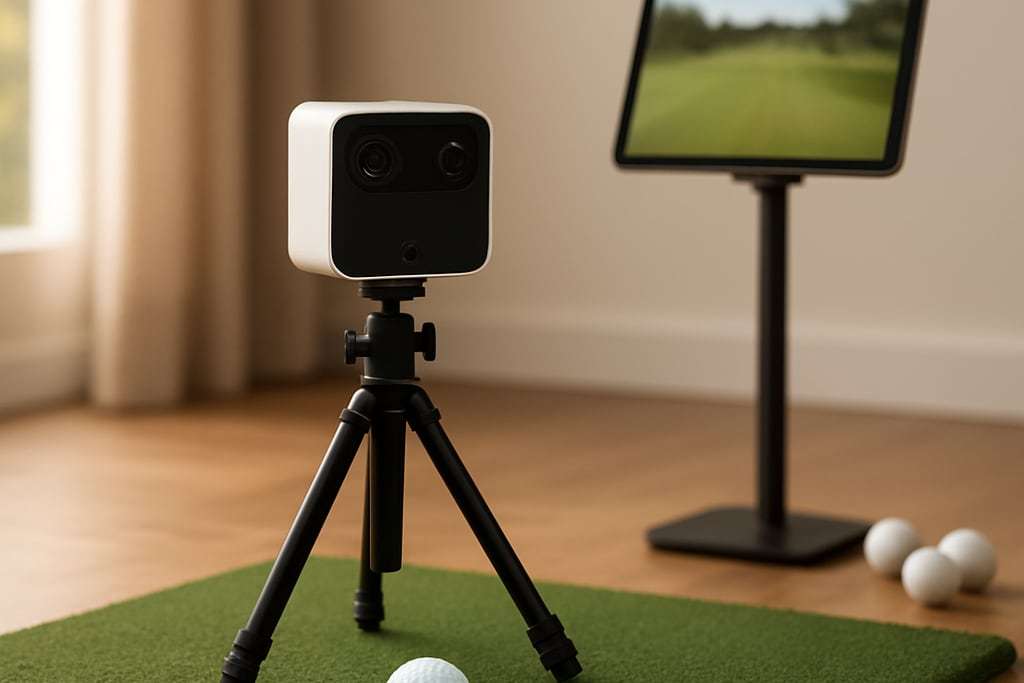
Camera (photometric) monitors use high-speed cameras and infrared to capture the moment of impact. They sit beside the ball or in front of it, and they read face angle and impact location directly. They do not follow the whole flight. They measure at the start and the software calculates the rest.
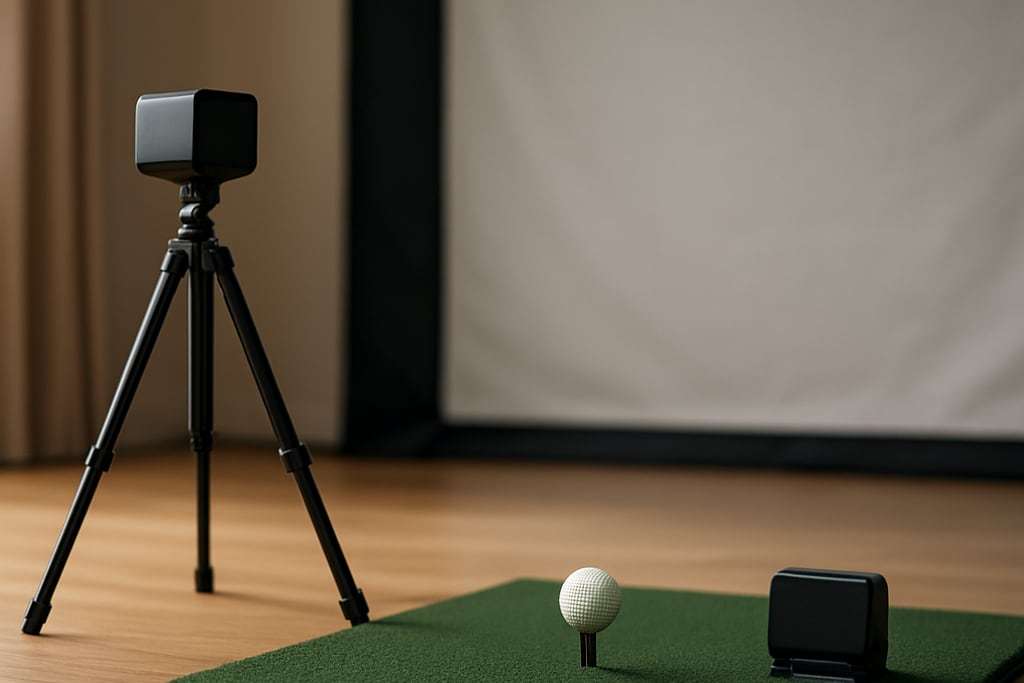
Overhead camera monitors hang from the ceiling above the hitting area, so nothing sits on the floor. The Uneekor EYE XO, ProTee VX and Trackman iO are examples.
Hybrids combine both. The SkyTrak ST Max (from $1,695) pairs dual Doppler radar with photometric cameras, and the Rapsodo MLM2PRO (from $549.99) pairs radar with two cameras. Golfer’s Authority says hybrids track 15 to 18 parameters in total.
Schematic, not to scale. Radar distances are from Golfer's Authority and Shop Indoor Golf; check the model's own placement figure.
How much room each type needs
This is the question that decides most purchases. The two retailers below publish different numbers, so both are shown.
| Type | Shop Indoor Golf (H x W x D, ft) | Golfer’s Authority |
|---|---|---|
| Camera beside the ball | 10 x 12-13 x 15-16 | About 10 ft deep, 10 ft wide, 9-10 ft high |
| Camera mounted overhead | 10 x 13-15 x 15-16 | Not listed separately |
| Radar behind the golfer | 10 x 12-15 x 16-19 | 16-21 ft deep, about 14 ft wide, 9-10 ft high |
Two sellers, two sets of assumptions. The solid part of each bar is the published range; the pale part is the distance up to it.
Radar needs about twice the depth because the unit sits 6 to 8 feet behind you and then needs space for the ball to fly. Shop Indoor Golf says radar needs at least 8 feet of ball flight from the mat to the screen.
Some units can be set closer. FlightScope’s FAQ puts the Mevo 4 to 7 feet behind the ball indoors, with 8 feet of ball flight, and says wedges read best at 4 feet and drivers at 7 feet. Carl’s Place lists the Full Swing KIT radar 10 feet behind the tee, with more space giving more data. Ask the seller for the model’s own figure before you rely on a category average.
For full wall-to-wall planning, see our room size guide.
What happens indoors
Radar’s weak spot indoors is the short flight. Golfer’s Authority says it tracks roughly the first 8 to 10 feet in a confined space and cannot see the ball reach its apex. Metal objects nearby can affect radar readings, and placement matters.
Camera units have a different set of chores. They need steady light, with no direct sun on the lens. Golfer’s Authority also notes more upkeep, such as lens cleaning, sticker replacement and the occasional recalibration. With SkyTrak, it says the ball should sit within 1 to 2 inches of the red laser dot.
Overhead units add a ceiling requirement. Carl’s Place lists the Uneekor EYE XO and XR at 9 to 10 feet above the hitting surface, the Foresight Falcon at 9.5 to 10.5 feet and the NVISAGE N1 at 9 to 10 feet. Check your ceiling, and the lowest pipe, duct or beam in the swing zone, before choosing one.
Accuracy: what can and cannot be said
There is no independent comparison to cite, so this page does not rank accuracy. Every accuracy figure on a store page is the maker’s claim. If a figure matters to you, look for a figure the maker states for your own use, such as carry distance with irons, and keep in mind it describes ideal conditions.
What the documentation does say clearly is how the data is gathered. Camera units read the club and ball at impact. Radar reads the ball after impact. The Rapsodo MLM2PRO measures spin from RPT-marked balls, and the Square Golf Home measures spin, face angle and angle of attack with club stickers and dotted balls. Check what comes in the box and what you have to replace later.
What each type costs
Prices below are the starting prices we list for each unit.
| Unit | Type | Price |
|---|---|---|
| Garmin Approach R10 | Radar | $499.99 |
| Rapsodo MLM2PRO | Radar + camera | from $549.99 |
| Square Golf Home | Camera, beside the ball | $699.99 |
| FlightScope Mevo Gen2 | Radar + camera | from $1,149 |
| Uneekor EYE MINI LITE | Camera | from $1,699 |
| Foresight GC3 | Camera | from $3,999 |
| Uneekor EYE XO | Overhead camera | from $4,999 |
| Trackman iO | Radar + camera, overhead | from $13,995 |
Radar units are cheaper on average, and camera units generally cost more. The price of the monitor is only the start, because software can be a separate yearly fee. Our software subscriptions guide shows which monitors need one.
Which type fits which room
- Room 15 feet deep or less: a camera unit beside the ball, such as the Square Golf Home, which its listing says needs almost no depth behind the golfer. A hybrid such as the Mevo Gen2 can also work with its indoor settings, but confirm depth with the seller.
- Room 16 feet or more, tight budget: a radar unit such as the Garmin Approach R10 gives you the lowest price on this list.
- Ceiling 9 to 10 feet, floor space tight: an overhead unit, if you can afford it and the mount height fits.
- Left- and right-handed players in one room: an overhead unit has no handedness issue, as it is fixed above the hitting area. Beside-the-ball units have to be moved to the other side.
If you are weighing the two most-searched entry radar units, our Garmin R10 vs Rapsodo MLM2PRO comparison goes line by line.
Run the numbers
The room size calculator tells you which technology your room can take, and all comparisons lists the monitor pages.
Mistakes to avoid
- Buying radar for a 10 to 12 foot deep room. Radar figures call for 16 to 21 feet.
- Ignoring the cost of the extras. Marked balls, stickers, a PC and yearly software can add up quickly.
- Mounting an overhead unit without checking the ceiling. Measure to the lowest obstruction in the swing zone, not just the ceiling surface.
Radar or camera is a room question before it is a brand question. Once you know your depth, our launch monitor buying guide narrows the choice by budget.
Frequently asked questions
Do radar launch monitors work indoors?
They can, but they have to be placed carefully. Golfer's Authority says radar struggles indoors because it cannot follow the ball to its apex in a confined space, and tracks only roughly the first 8 to 10 feet. FlightScope's FAQ gives 8 feet of ball flight for indoor use with the Mevo placed 4 to 7 feet behind the ball.
Which type needs less room, radar or camera?
Camera (photometric) units need less depth. Golfer's Authority puts a camera unit at about 10 feet of total depth and a radar unit at 16 to 21 feet. Shop Indoor Golf's table lists 15 to 16 feet of depth for camera units and 16 to 19 feet for radar. The two retailers use different assumptions, so measure your own room against both.
Are camera launch monitors more accurate than radar?
There is no independent test to cite, so this site does not rank accuracy. Accuracy figures on retailer pages are the makers' own claims. What the published material does say is that camera units read the club and ball at impact, while radar follows the ball after it leaves the club.
Do camera monitors work with regular golf balls?
Mostly. Golfer's Authority says most photometric units, such as the Foresight GCQuad and Uneekor EYE XO, work with regular balls, while Square Golf requires marked balls. Check the product page, because the Rapsodo MLM2PRO also needs its marked balls for spin readings.
Can lighting affect a camera launch monitor?
Yes. Photometric units need consistent lighting, and direct sun on the lens is a problem. Shop Indoor Golf recommends uniform, indirect, flicker-free LED light because cameras can pick up flicker. Radar is not affected by ambient light.