The short answer
The Garmin Approach R10 is a $499.99 Doppler radar launch monitor that reports 14 metrics per shot and runs Garmin Home Tee Hero courses with an active Garmin Golf subscription. It suits a budget build in a room at least 16 ft deep. In a short room, look at a camera monitor instead.
We earn a commission when you buy through some links on this site, at no extra cost to you. It never changes what we recommend.
Left-handed golfers mirror the layout. If you hit from off-centre, each side still needs room for the swing: check the nearer wall first.
Our picks
Approach R10
Launch monitor (radar)
$499.99. Doppler radar, 14 metrics per shot including ball speed, launch angle, spin rate and smash factor, about 10 hours of battery and a swing video clip with data overlay.
- TechnologyDoppler radar
- SoftwareGarmin Home Tee Hero, 43,000 courses; active Garmin Golf subscription required
- BatteryAbout 10 hours
Listed price$499.99
Check price at Carl's PlaceSpecs & trade-offs
- Technology
- Doppler radar
- Data
- 14 metrics per shot, including ball speed, launch angle, spin rate and smash factor
- Battery
- About 10 hours
- Weight
- Under half a pound, carrying case included
- Software
- Garmin Home Tee Hero, 43,000 courses; active Garmin Golf subscription required
- Video
- Records a clip of every swing with data overlay
- Among the lowest-priced monitors that can run simulator courses
- Small enough to move between garage, backyard and range
- Course play needs an active Garmin Golf subscription
- Radar-based, so it needs room behind the ball
- Needs a net or screen, mat, projector and a device to become a full simulator
Garmin R10 Practice Bundle
Simulator package
From $1,599 with a SwingNet Pro XL 8x8 net and a SwingTurf mat in 5x5 or 4x9.
- Launch monitorGarmin Approach R10
- NetSwingNet Pro XL 8x8
- MatSwingTurf 5x5 or 4x9
Listed pricefrom $1,599
Check price at Rain or Shine GolfSpecs & trade-offs
No projector or screen, so it is a net practice setup, not a full sim.
- Launch monitor
- Garmin Approach R10
- Net
- SwingNet Pro XL 8x8
- Mat
- SwingTurf 5x5 or 4x9
- Portable
- Low price for a bundle
- No projector or screen included
- Garmin Golf subscription for courses
- A net practice setup, not a full sim
Ready-to-Golf Garmin R10 Bundle
Simulator package
From $4,995 with Carl's DIY enclosure and a premium impact screen.
- Launch monitorGarmin Approach R10
- EnclosureCarl's DIY enclosure with premium impact screen
Listed pricefrom $4,995
Check price at Carl's PlaceSpecs & trade-offs
The projector and mat may be extra, and courses need the Garmin Golf membership.
- Launch monitor
- Garmin Approach R10
- Enclosure
- Carl's DIY enclosure with premium impact screen
- Real impact screen with an entry monitor
- One order
- Garmin Golf membership for courses
- Projector and mat may be extra
- Large bundle price for an entry monitor
MLM2PRO
Launch monitor (radar + camera)
From $549.99. Radar plus two cameras, with club-face video at 240 fps.
- TechnologyDoppler radar plus two cameras
- VideoSwing replay and Impact Vision club-face video at 240 fps
- SpinMeasured with RPT-marked balls; 3 Callaway Chrome Soft X balls included
Listed pricefrom $549.99
Check price at Carl's PlaceSpecs & trade-offs
Spin readings need the marked balls.
- Technology
- Doppler radar plus two cameras
- Video
- Swing replay and Impact Vision club-face video at 240 fps
- Spin
- Measured with RPT-marked balls; 3 Callaway Chrome Soft X balls included
- Club data
- Club path and angle of attack measured since May 2025
- Connection
- iPhone, iPad or Android device
- Radar plus dual cameras at a low price
- Shows the club face at impact
- Spin data needs the marked balls
- Course play needs extra software (GSPro is $250 for the first year)
- Depends on a phone or tablet
| Model | Best for | Type | Listed price |
|---|---|---|---|
| Approach R10 | The monitor itself | Launch monitor (radar) | $499.99 |
| Garmin R10 Practice Bundle | R10 with a net and mat | Simulator package | from $1,599 |
| Ready-to-Golf Garmin R10 Bundle | R10 with a real enclosure | Simulator package | from $4,995 |
| MLM2PRO | Closest alternative | Launch monitor (radar + camera) | from $549.99 |
The Garmin Approach R10 is one of the lowest-priced monitors that can run simulator courses. This review is based on published specifications and documentation from retailer and dealer pages, not on hitting balls with one, so read it as a guide to what the unit says it does and what it needs from your room.
What the R10 is
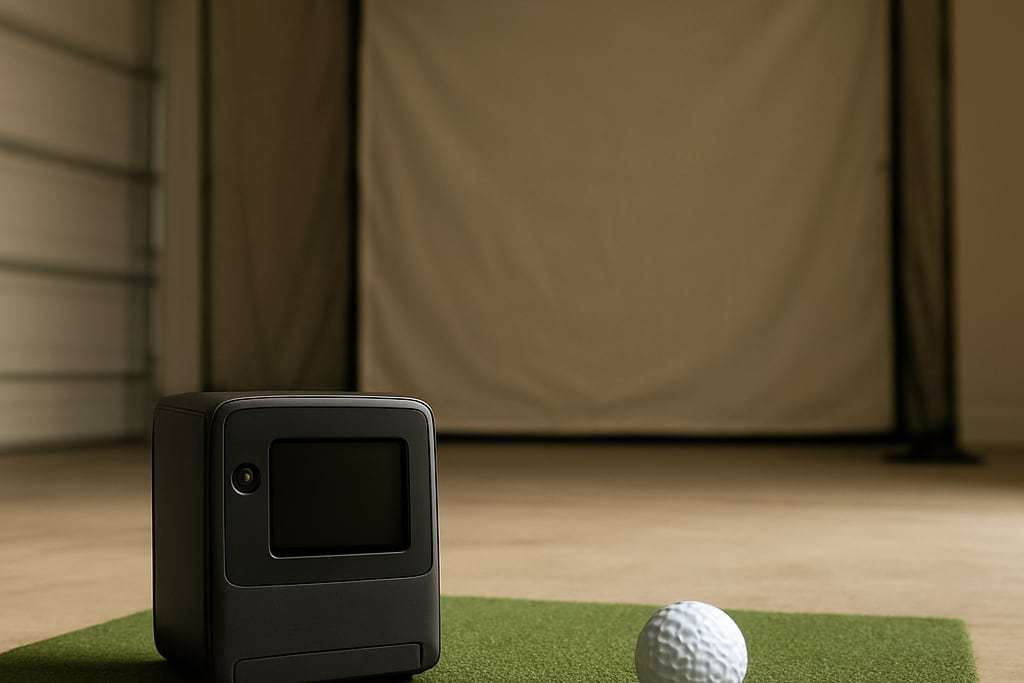
The R10 is a Doppler radar launch monitor. It sits behind the golfer, tracks the ball in flight and reports numbers. It weighs under half a pound, comes with a carrying case and lists about 10 hours of battery. That makes it easy to move between a garage, a backyard and a range.
It reports 14 metrics per shot, including ball speed, launch angle, spin rate and smash factor. It also records a video clip of every swing with a data overlay. For simulator play it connects to Garmin Home Tee Hero, which lists 43,000 courses and needs an active Garmin Golf subscription. The retailer pages do not give a subscription price, so confirm the current cost with Garmin.
How radar works, and what that means for space
Radar units emit microwaves and track the ball as it flies. Golfer’s Authority says radar sits 6 to 8 ft behind the golfer and does not care about ambient light. It also says radar tracks roughly the first 8 to 10 ft of flight indoors, because a confined room does not let it follow the ball to the top of its arc.
Space is the main trade-off. In Shop Indoor Golf’s room table, doppler radar monitors behind the golfer, including the R10, need about 10 ft of height, 12 to 15 ft of width and 16 to 19 ft of depth. Camera monitors that sit beside the ball need 15 to 16 ft of depth. Golfer’s Authority puts the radar total at 16 to 21 ft, counting 6 to 8 ft behind the golfer plus about 8 ft of ball flight.
A PlayBetter FAQ copy of the R10 manual says to put the unit about 6 to 8 ft behind the ball and at least 8 ft from the net. Other manual copies say about 8 ft behind, so use Garmin’s current guide.
| Setting | Depth guidance for radar |
|---|---|
| Behind the ball | about 6 to 8 ft |
| Ball flight to screen | at least 8 ft |
| Whole room (Shop Indoor Golf) | 16 to 19 ft |
| Whole room (Golfer’s Authority) | 16 to 21 ft |
If your room is shorter than that, read the radar vs camera guide before you buy. The room size guide covers the full layout.
Software and cost
The R10’s own pitch is course play at a low entry price, but the full cost is the monitor plus the subscription. The retailer listing names the cons plainly: course play needs an active Garmin Golf subscription, radar needs room behind the ball, and the monitor needs a net or screen, mat, projector and a device to become a full simulator.
A realistic build runs like this, using the prices in the picks above:
- Monitor only: $499.99.
- Net and mat practice bundle: from $1,599 at Rain or Shine, with a SwingNet Pro XL 8x8 net and a SwingTurf mat.
- Enclosure bundle: from $4,995 at Carl’s Place, with a DIY enclosure and a premium impact screen. The projector and mat may be extra.
Every number is the seller’s listed price and moves, so check the page. For the complete cost picture, see the simulator cost guide.
Where the R10 fits
On paper the R10 suits three buyers. One wants the lowest cost of entry to a sim. One wants a portable monitor that works at the range and in the garage. One wants to try simulator golf before spending on a camera system.
It is a weaker fit for a room under about 16 ft deep, for a buyer who wants swing video of the club face at impact (the MLM2PRO lists that) and for anyone who dislikes subscriptions. Compare it with the closest alternative in our Rapsodo MLM2PRO review and the head-to-head.
Setting it up in a home room
Because the R10 is radar, room light does not matter to it. Golfer’s Authority says radar is unaffected by ambient light and works indoors and outdoors, so a dim basement or a bright garage is no problem for the monitor itself. The same source warns that radar accuracy can be affected by metal objects and needs careful placement, which is worth remembering in a garage full of shelving, tools and a car.
Placement is the part to plan on paper. The unit goes behind the golfer, so you need a spot for it that is out of the swing path and still 8 ft or more from the screen. At under half a pound it is easy to move out of the way when you want the garage back.
Because it reports through a phone, tablet or computer, you also need a device near the hitting area and a way to show the course on a bigger display. Our projector picks cover the display side of the build.
Accuracy
We found no independent accuracy test of the R10, so we make no claim about it. Anything Garmin says about its accuracy is the maker’s claim, and Garmin’s documentation is the place to see how each of the 14 metrics is produced.
Run the numbers
Add the R10, a net, a mat and a yearly Garmin Golf plan in the cost calculator, and check the 16 feet of depth with the room size calculator. See all comparisons for other monitor comparisons.
Who should skip the R10
- Anyone with a room shorter than about 16 ft. Radar needs ball flight and depth behind the ball. Look at camera monitors in the small room guide.
- Anyone who wants no subscription. The FlightScope Mevo Gen2 lists a permanent license to 8 E6 Connect courses, per the seller. See the subscriptions guide.
- Anyone who wants a complete simulator in one box. The R10 is only the monitor. A simulator package bundles the rest.
Common buying mistakes
- Pricing the monitor and forgetting the subscription. Add the Garmin Golf membership to the yearly cost.
- Measuring the room but not the depth behind the ball. Radar needs room behind you, not only in front.
- Expecting net-bundle prices to give a full sim. The $1,599 bundle has no projector or screen.
- Reading forum accuracy claims as fact. Without independent tests, treat them as opinion.
- Skipping the swing check. Measure your own swing and clearance before you hit in a small room.
Frequently asked questions
Does the Garmin R10 need a subscription to play courses?
The retailer listing says course play on Garmin Home Tee Hero needs an active Garmin Golf subscription. Garmin sets the current price and terms, so check them before you buy. Garmin's page should also say what the unit does without a plan.
How much room does a Garmin R10 need?
It is a radar unit, so it needs depth. A radar monitor needs at least 8 ft of ball flight from mat to screen, according to Shop Indoor Golf, and its room table puts radar setups at 16 to 19 ft deep. A manual copy on PlayBetter says to place the R10 about 6 to 8 ft behind the ball and at least 8 ft from the net, but other manual copies say about 8 ft, so measure with the maker's current guide.
Can the R10 work indoors?
Yes, but radar is weaker indoors. Golfer's Authority says radar struggles because it cannot see the ball to its apex in a confined space and tracks roughly the first 8 to 10 ft. Radar is not affected by room light, so a dark basement is fine.
How accurate is the Garmin R10?
No independent test comparing launch monitor accuracy was available, so treat any accuracy statement as the maker's claim. Garmin lists 14 metrics per shot, including spin rate.
What else do I need to make it a simulator?
A net or an impact screen, a hitting mat, a projector for course play and a phone, tablet or computer. The R10 alone is a monitor, not a simulator.