The short answer
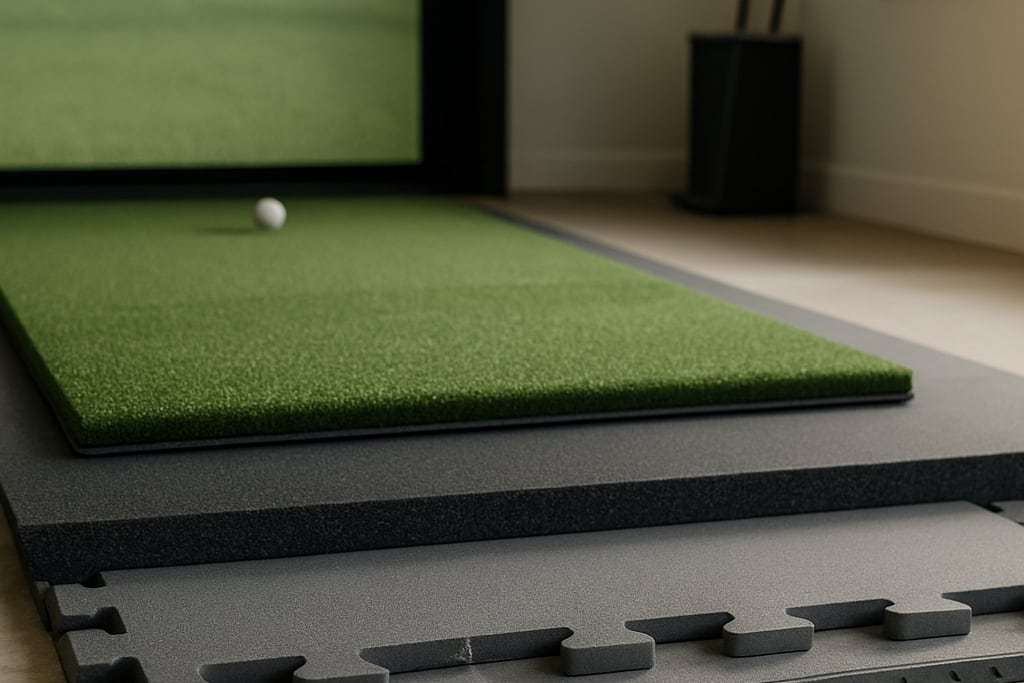
Golf simulator flooring is usually a stack: a firm base, a cushion layer such as 1.5 inch foam board or 2 to 4 inch rubber mats, then the hitting mat on top. Concrete is hard and cold, so the cushion matters. Every layer also takes ceiling height, so add the thickness before you trust a measurement.
What the floor has to do
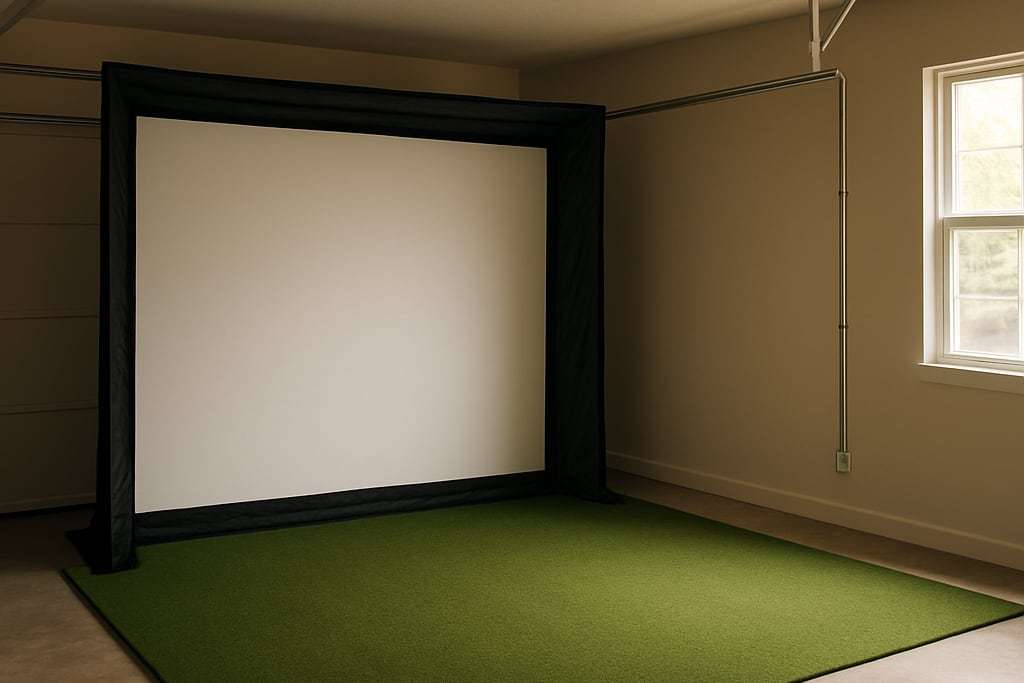
A golf simulator floor has four jobs. It has to hold a hitting mat firmly in one place, absorb some of the shock of each swing, keep a concrete slab from feeling like a sidewalk, and spare the floor underneath from damage. Most guides describe the answer as layers, not one product.
Most of this guidance comes from retailers and makers, so the numbers below are what sellers recommend, not independent test results. No test comparing foam thickness with joint strain is cited here, so treat anything about joints as general advice, and ask a clinician if you have an elbow, wrist or back problem.
The layer stack, bottom to top
Start with what the room already has. A garage or basement slab is concrete, and Carl’s Place describes basement concrete as cold and hard: add a subfloor, foam tiles or padding. Shop Indoor Golf’s garage page says landing-pad turf and flooring upgrades give a stable base, and that concrete is hard, so the mat and foam matter.
| Layer | Typical choice | Source |
|---|---|---|
| Base | Concrete slab, sealed or finished | Carl’s Place |
| Cushion | 1.5 inch foam board, or 2 to 4 inch rubber mats | Golfer’s Authority |
| Budget cushion | 5/8 inch gym mats | Golfer’s Authority |
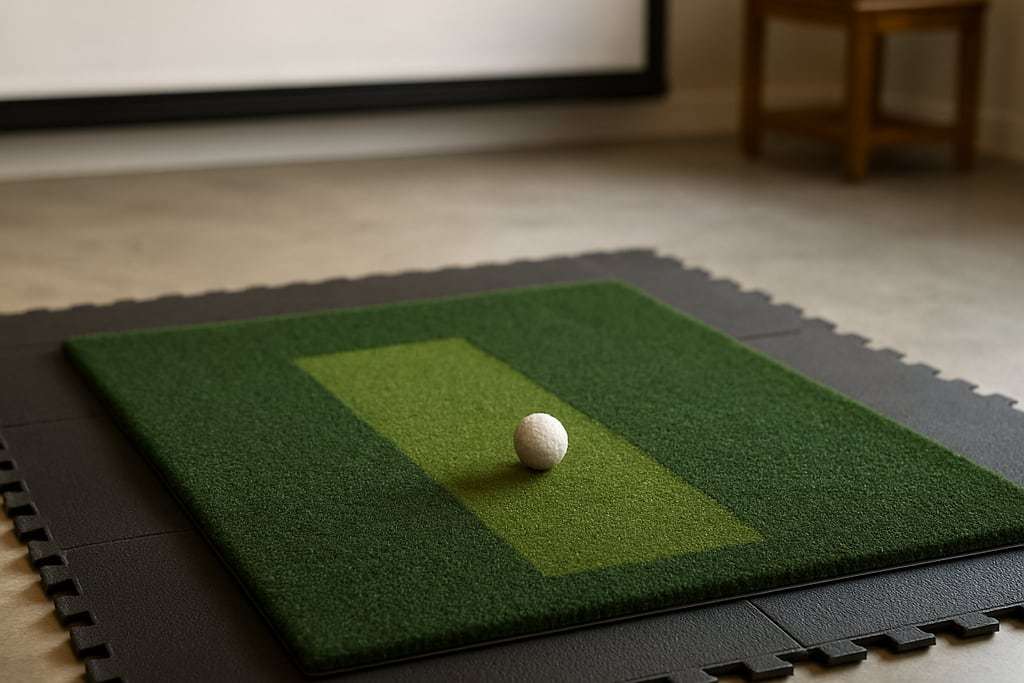
| Basement option | Foam puzzle tiles with a recess cut for the mat | Carl’s Place |
| Hitting surface | Mat with built-in foam, or a hitting strip | See below |
Carl’s Place sells a floor tile system from $59.95. A mat with its own foam underlayer needs less help from the floor, and a thin one needs more.
Cut a recess in the cushion layer so the mat sits flush with the surrounding floor, which Carl’s Place recommends. Otherwise you step up onto the mat, and the edge can catch a foot or a club.
Choosing the hitting surface
Mats come in common sizes of 5 ft by 5 ft or 4 ft by 7 ft, according to Shop Indoor Golf. The ones on our hitting mat picks page run from SwingTurf from $399 (sizes 4x4, 5x5, 4x7) and Country Club Elite from $479 (4x5, 5x5, 5x8) up to the Carl’s HotShot Golf Mat System from $499.95, the Fiberbuilt Launch Monitor Studio 4x9 at $1,499 and the SIGPRO Super Softy Double Sided Mat at $1,799.99, which has a rubber tile base.
The pricier mats are built for both handedness: the Fiberbuilt center-hitting mat is listed for left and right handed players, and the SIGPRO Super Softy is double sided. Check the monitor maker’s layout before you cut a recess.
Protecting the floor and the mat
Hitting surfaces wear, and the strip where you hit wears first. That is why Carl’s HotShot system uses replaceable inserts.
For a finished floor such as hardwood, no source here gives a tested method, so treat this as planning advice: put a rubber or foam layer under the mat, keep the edges bound so the stack cannot creep, and ask the floor’s installer about marks from heavy gear. If you plan a permanent room, a subfloor is the cleaner answer, as Carl’s Place suggests for basements.
Moisture matters in basements. Carl’s Place says basements hold more moisture and suggests a dehumidifier to protect turf, the screen and electronics.
Count the height you lose
Every layer is thickness taken from the ceiling. Golfer’s Authority says to add 2 to 3 inches for the mat and subtract padding from your ceiling: its example is a 9 foot ceiling minus 2 inches of foam, leaving 8 feet 10 inches. Rapsodo and Golfer’s Authority both say the ceiling should be 6 to 9 inches taller than the height of your swing. The room size calculator lets you enter a ceiling height after subtracting the floor stack.
If you are already tight, a thin mat on a firm base beats a thick stack. Use a cushion only where it adds comfort you will actually feel.
Noise and the floor
Second Skin Audio says the sharp impact noise comes from the club striking the ball and the ball hitting the screen, and it sells a mat to go under a golf mat. That is a vendor’s claim and no independent measurement is cited here, so treat flooring as a small part of the noise plan. The garage build plan covers walls, ceiling and power.
Garage specifics
Shop Indoor Golf recommends protecting electronics from extreme cold and heat, and keeping the launch monitor and laptop indoors where humidity and condensation are controlled. A cold slab is one more reason to put a cushion between you and the concrete.
Run the numbers
Add the flooring layers to the cost calculator, since foam, rubber and the mat can cost as much as the screen.
Mistakes to avoid
- A mat that is too small or too hard. aboutGOLF lists both among common mistakes. Match the mat to the way you stand and swing, and add a cushion under a hard one.
- Forgetting the height. A stack of foam and rubber can quietly take 3 inches or more, and that is the margin between clearing a driver and clipping a fixture.
- Skipping the recess. A mat that sits proud of the floor is an edge to catch a foot.
- Leaving dust. Carl’s Place warns that concrete dust settles on electronics, so seal the slab or finish the floor first.
A simple order of work
- Measure the ceiling at the hitting spot, and write down the lowest obstruction.
- Decide the stack and add its thickness to the mat.
- Clean and seal the slab.
- Lay the cushion, cut the recess and set the mat flat.
- Test a slow swing with your longest club, then check the height again.
Whatever you choose, test a full backswing on the actual stack before you attach the screen and projector, and see the DIY enclosure guide for the frame that goes around it.
Frequently asked questions
What should go under a golf simulator hitting mat?
Golfer's Authority lists 1.5 inch foam board or 2 to 4 inch rubber mats under the hitting mat, with 5/8 inch gym mats as a budget option. Carl's Place suggests cushioned foam puzzle tiles for a basement, with a recess cut so the mat sits flush. Pick one cushion layer and keep the stack firm enough that the mat does not rock.
How much ceiling height does flooring use?
Golfer's Authority says to add 2 to 3 inches for mat thickness and gives a worked example: a 9 foot ceiling minus 2 inches of foam leaves about 8 feet 10 inches of clearance. Add every layer you plan, then measure your swing against what is left.
Can I put a hitting mat straight on concrete?
You can, but concrete is hard and cold, and Carl's Place recommends a subfloor, foam tiles or padding in a basement. A thin, hard mat gives little shock absorption, and aboutGOLF lists a mat that is too small or too hard among common mistakes. Choose a mat with built-in foam and add a pad if it feels harsh.
Will a hitting mat protect hardwood or finished floors?
Simulator flooring guides mostly cover concrete and give no tested method for hardwood. A mat is a protective surface, but a heavy mat edge or loose layers can still mark a finished floor. Put a rubber or foam layer under the mat and check with the floor's maker or installer before you hit.
Does flooring reduce noise?
A little at most. Second Skin Audio says the sharp impact noise comes from the club striking the ball and from the ball hitting the screen, and it sells a mat to go under the golf mat, so treat its claims as a vendor's. Plan noise as a whole-room job, not a flooring job.