The short answer
A hitting mat decides how the club meets the ground, and a thin, hard one jars the hands and wrists. For most first builds, start with the SwingTurf Golf Hitting Mat, from $399, which Rain or Shine lists with a softer fiber surface aimed at less recoil. Check the size against your launch monitor before you buy.
Some links on this site may earn us a commission if you buy, at no extra cost to you. It never changes what we recommend.
Our picks
Labels describe listed features and prices from maker and seller pages, not test results.
SwingTurf Golf Hitting Mat
Hitting mat
From $399 in 4x4, 5x5 and 4x7. The softer fiber surface is aimed at less recoil, but only the smaller sizes sit at the low price and a pad may be needed on hard floors.
- Sizes4x4, 5x5, 4x7
- SurfaceSofter fiber surface
Listed pricefrom $399
Check price at Rain or Shine GolfSpecs & trade-offs
- Sizes
- 4x4, 5x5, 4x7
- Surface
- Softer fiber surface
- Softer surface aimed at less recoil
- Low starting price
- Smaller sizes only at the low price
- Surface wears
- A pad may be needed on hard floors
Country Club Elite Real Feel Mat
Hitting mat
From $479 in 4x5, 5x5 and 5x8, built with CCE Real Feel construction.
- Sizes4x5, 5x5 and 5x8
- ConstructionCCE Real Feel
Listed pricefrom $479
Check price at Rain or Shine GolfSpecs & trade-offs
Prices rise with size, and the smallest option is 4x5.
- Sizes
- 4x5, 5x5 and 5x8
- Construction
- CCE Real Feel
- Low entry price
- Several sizes
- Smallest size is 4x5
- Surfaces wear
- Prices rise with size
HotShot Golf Mat System
Hitting mat
From $499.95. The HotShot system uses replaceable inserts, so worn strips can be swapped.
- TypeCarl's HotShot mat system with replaceable inserts
Listed pricefrom $499.95
Check price at Carl's PlaceSpecs & trade-offs
Check the page for exact sizes.
- Type
- Carl's HotShot mat system with replaceable inserts
- Replaceable strips
- Sold by the same dealer as the enclosure
- Strips wear and need replacing
- Size options add cost
- Check the page for exact sizes
Launch Monitor Studio 4x9 Center Hitting
Hitting mat
$1,499 for a 4x9 center-hitting mat made for launch-monitor sims, with a grass-blade turf feel.
- Size4x9
- LayoutCenter hitting for left and right handed players
- ConstructionGrass-blade turf feel
Listed price$1,499
Check price at Rain or Shine GolfSpecs & trade-offs
It needs a firm, level surface.
- Size
- 4x9
- Layout
- Center hitting for left and right handed players
- Construction
- Grass-blade turf feel
- Suits both left and right handed players
- Made for launch-monitor sims
- High price for a mat
- Needs a firm, level surface
- Large footprint
SIGPRO Super Softy Double Sided Mat
Hitting mat
$1,799.99 for a 4' x 8'4" mat with two Super Softy hitting strips (12 inch by 48 inch) on a rubber tile base.
- Size4' x 8'4"
- Strips2 Super Softy hitting strips, 12 inch by 48 inch
- BaseRubber tile
Listed price$1,799.99
Check price at Shop Indoor GolfSpecs & trade-offs
The seller aims it at commercial settings.
- Size
- 4' x 8'4"
- Strips
- 2 Super Softy hitting strips, 12 inch by 48 inch
- Base
- Rubber tile
- Left and right handed use
- Stable rubber tile base
- High price
- Large footprint
- Aimed at commercial settings
Quick comparison (prices change often; check the seller for today's price)
| Model | Listed price | Best for | Type | Seller link |
|---|---|---|---|---|
| SwingTurf Golf Hitting Mat | from $399 | Softer surface, lowest starting price | Hitting mat | Check price at Rain or Shine Golf |
| Country Club Elite Real Feel Mat | from $479 | Most size choices under $500 | Hitting mat | Check price at Rain or Shine Golf |
| Carl's Place HotShot Golf Mat System | from $499.95 | Replaceable hitting strips | Hitting mat | Check price at Carl's Place |
| Fiberbuilt Launch Monitor Studio 4x9 Center Hitting | $1,499 | Made for left and right handed use | Hitting mat | Check price at Rain or Shine Golf |
| SIGPRO Super Softy Double Sided Mat | $1,799.99 | Heavy-duty double-sided mat | Hitting mat | Check price at Shop Indoor Golf |
The mat is where the club meets the ground, so it affects feel, wear on your hands and where the launch monitor can sit. It is also the part most buyers pick last. These picks come from sellers’ published specifications and prices, not our own use, and no independent test comparing foam thickness with injury rates exists, so read any comfort claim as marketing.
What a mat does in a simulator
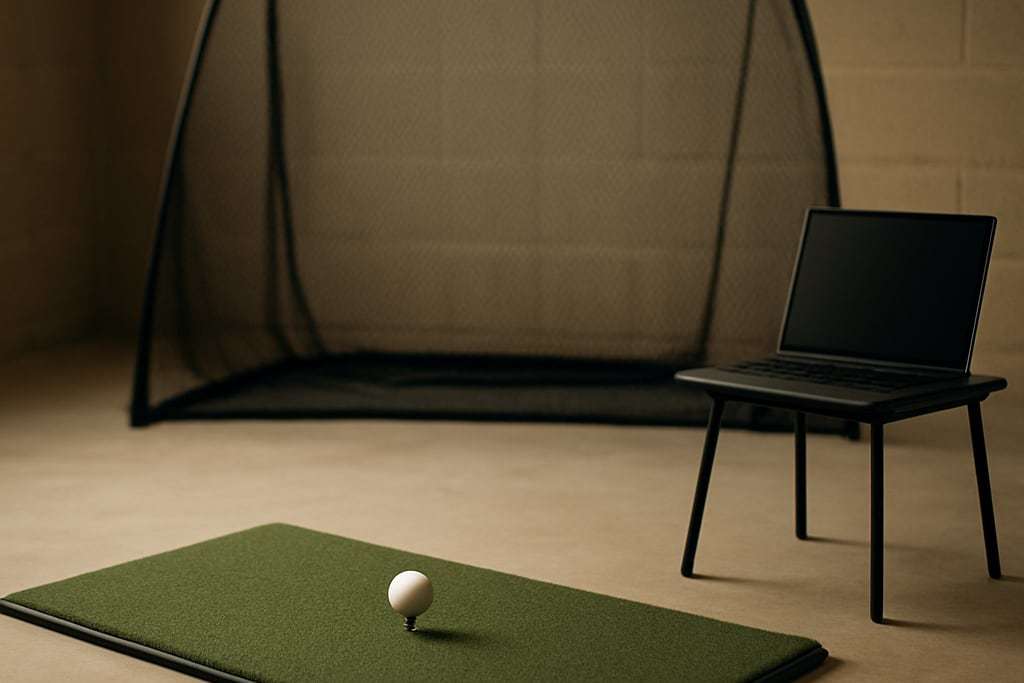
A simulator mat has to do three jobs. It has to give a surface that lets the club slide through. It has to cushion impact. And it has to hold the ball in a spot the launch monitor can read.
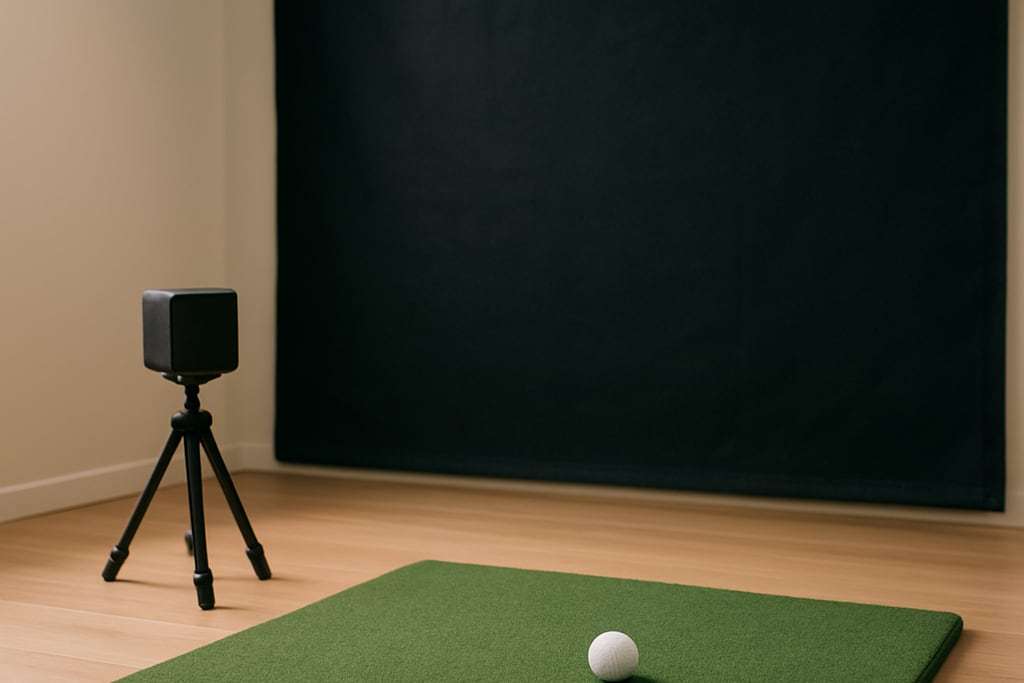
That last job is easy to forget. A radar unit behind you does not care where the ball sits, but a camera monitor does. SkyTrak, for example, wants the ball within 1 to 2 inches of its red laser dot, with drivers and woods 1 to 2 inches behind the dot and wedges and irons 1 to 2 inches in front, per a Golfer’s Authority guide. Overhead units have a hitting zone too: Uneekor lists the EYE XO2’s at 28 inches wide by 21 inches long. Your mat has to cover that area. Our launch monitor guide explains which tech needs what, and the room size by launch monitor table lists named models.
Turf type and cushioning
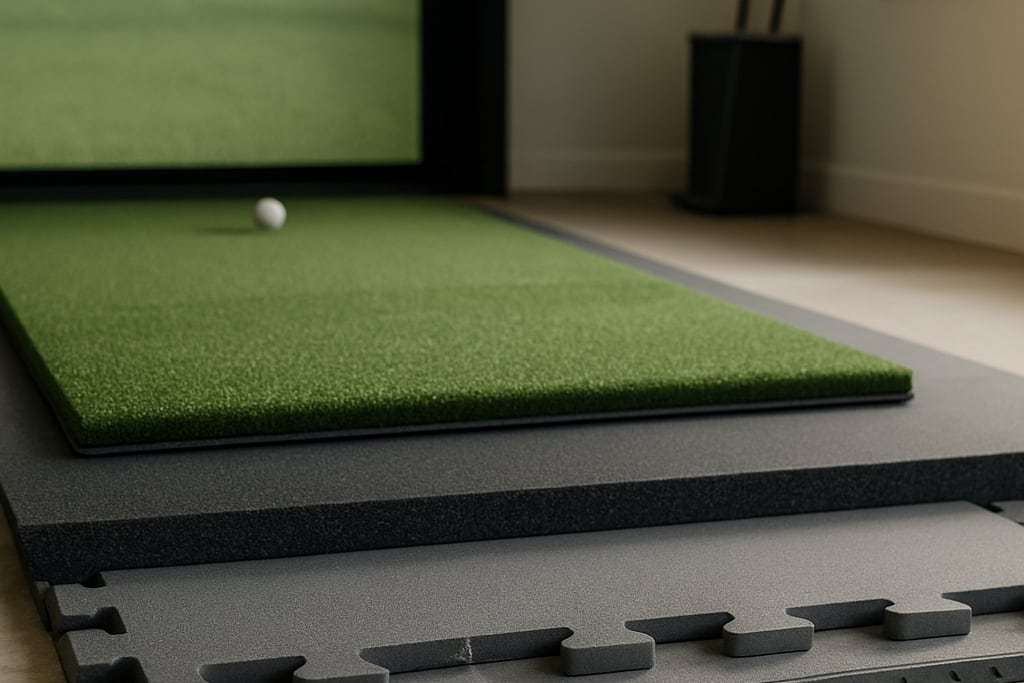
Most mats are turf over a foam layer, and foam under the turf is what cushions the hit. The trade-off cuts both ways. A thin, hard mat gives little shock absorption. On the other hand, one forum poster says very thick, dense turf can grab and slow the clubhead on a fat shot and links that to golfer’s elbow. That is a single anecdote, so treat it as a reason to compare, not a rule.
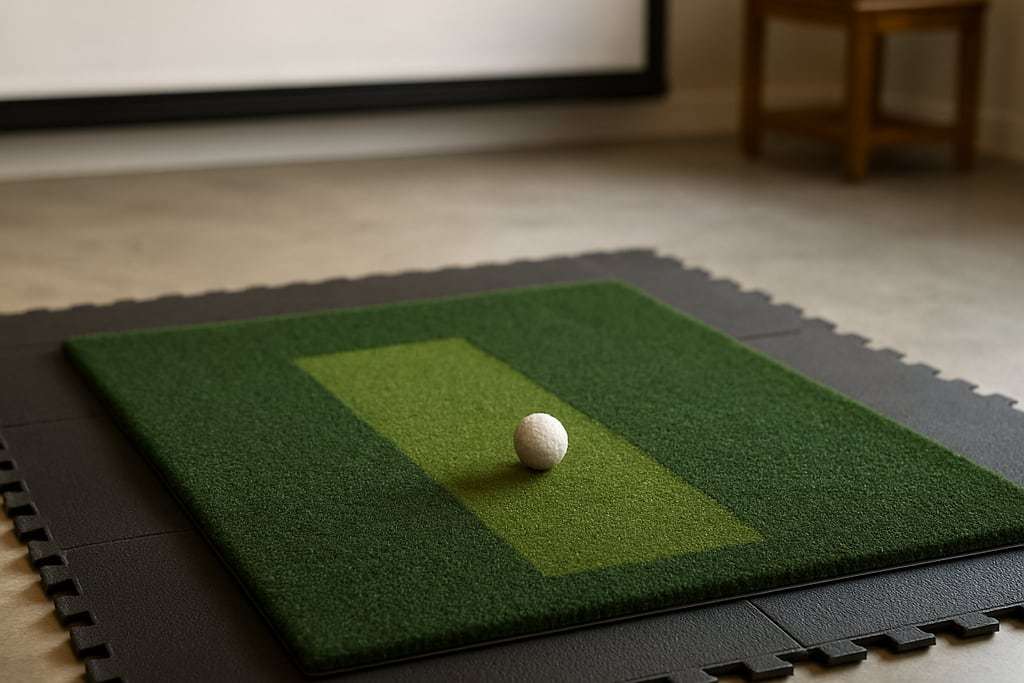
Hitting strips are one answer to wear. A strip is a narrow piece of turf over a thick foam core, set into a larger base; one seller’s example is about 30 by 12 inches. Carl’s HotShot system works this way with replaceable inserts, and the SIGPRO Super Softy uses two 12 by 48 inch strips on a rubber tile base. Strips mean you replace the worn part, not the whole mat.
No mat is a substitute for warming up. aboutGOLF recommends stretching before and after sessions and using a cushioned mat. If you have a joint condition, ask a professional.
Size, layout and handedness
Shop Indoor Golf lists 5 ft by 5 ft and 4 ft by 7 ft as common sizes. The sizes in the picks run from 4x4 to 5x8 for the budget mats and 4x9 for the Fiberbuilt.
| Pick | Sizes | Price |
|---|---|---|
| SwingTurf | 4x4, 5x5, 4x7 | from $399 |
| Country Club Elite Real Feel | 4x5, 5x5, 5x8 | from $479 |
| Carl’s HotShot Golf Mat System | check the page | from $499.95 |
| Fiberbuilt Launch Monitor Studio | 4x9 center hitting | $1,499 |
| SIGPRO Super Softy | 4’ x 8’4” | $1,799.99 |
For a household with both left and right handed players, a center-hitting layout or a double-sided mat avoids moving the mat. The Fiberbuilt is a center-hitting mat for left and right handed players, and the Super Softy is left and right handed too.
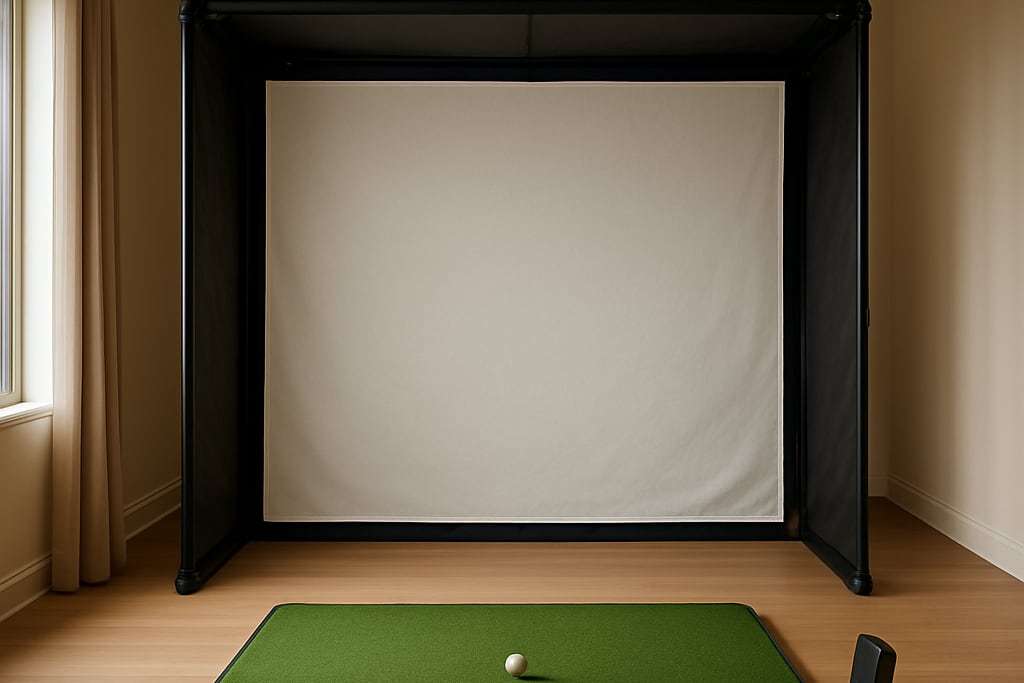
A beside-the-ball monitor can collide with a small mat. PlayBetter notes that Foresight’s SimStudio packages ship with a 5 ft by 5 ft mat that may not fit both a GC3 and your feet, and suggests raising the monitor to mat height if needed. Plan the monitor and the mat together, and see the small room guide if space is tight.
What goes under the mat
The floor decides the cushion. Concrete in a garage or basement is hard and cold. Carl’s Place suggests a subfloor, foam tiles or padding in a basement and a recess in the foam so the mat sits flush. Golfer’s Authority suggests 1.5 inch foam board or 2 to 4 inch rubber mats, with 5/8 inch gym mats as a budget option.
Every layer adds height. Golfer’s Authority says to add 2 to 3 inches for the mat, and to count foam too. On an 8 or 9 ft ceiling, that is clearance you may not have. Test your longest club on the whole stack before you buy. The flooring guide covers layering over concrete and hardwood.
The Fiberbuilt listing says it needs a firm, level surface, and the SwingTurf may need a pad on hard floors.
Wear and replacement
Every mat wears. The SwingTurf and Country Club Elite listings both note that surfaces wear, and the HotShot system is built around replaceable strips for that reason. If you hit a lot of balls from the same spot, a strip you can swap is a cheaper repair than a new mat.
Ask about replacement cost before you buy. A $1,499 or $1,799.99 mat costs several times what the budget mats do, and none of the listings states how many shots a surface lasts.
Run the numbers
A thick mat and underlay take ceiling height, so enter the reduced clearance into the room size calculator, and add the mat to your total in the cost calculator.
Who should skip a premium mat
- Anyone buying a bundle that already has a mat. Rain or Shine’s Garmin R10 and Rapsodo MLM2PRO practice bundles each include a SwingTurf mat, so check before buying one separately. The package guide compares bundles. For a mat-based infrared system, see the OptiShot 2 review.
- Budget builders testing the idea. A $399 to $499 mat is enough to find out whether you will use the sim. The budget simulator guide shows where to spend and where to hold back.
- Anyone with no room for a 4x9. The big center-hitting mats have a large footprint.
Common buying mistakes
- Buying a mat too small for monitor and feet. Check where the monitor sits first.
- Ignoring height. Add 2 to 3 inches for the mat and subtract any foam from your ceiling clearance.
- Assuming thicker means kinder to your joints. Thick turf can grab the club, and no independent injury data exists.
- Skipping the floor underneath. A mat laid straight on bare concrete gives the hands less cushion.
- Expecting a real tee to work. Some mats are built for tees and many are not.
Frequently asked questions
What size hitting mat do I need for a simulator?
Common sizes are 5 ft by 5 ft and 4 ft by 7 ft, according to Shop Indoor Golf. The right size depends on your launch monitor: a unit that sits beside the ball needs room next to your feet, and a mat that is too small for both is a common mistake.
Does the hitting mat add to the ceiling height I need?
Yes. Golfer's Authority says to add 2 to 3 inches for mat thickness, and its example subtracts a 2 inch foam pad from a 9 ft ceiling to get about 8 ft 10 in of clearance. Measure to the top of the mat, not the floor.
Will a thicker mat protect my elbows and wrists?
A foam layer under the turf cushions impact, and aboutGOLF advises a cushioned mat and stretching before and after sessions. No independent test links foam thickness to injury rates, so this is general advice, not medical guidance. If you have joint problems, ask a doctor or a coach.
Can I hit off a real tee?
Some mats are built so a real tee goes into the turf, per seller claims, and many are not. Check the listing for tee support if you want to hit drivers off a tee.
Do I need something under the mat on concrete?
Concrete is hard and cold, so most guides add cushioning. Golfer's Authority suggests 1.5 inch foam board or 2 to 4 inch rubber mats, with 5/8 inch gym mats as a budget option. Carl's Place suggests laying turf over cushioned foam puzzle tiles and cutting a recess so the mat sits flush.
Sources
- Shop Indoor Golf: how much space do you need for a golf simulator
- Golfer's Authority: golf simulator ceiling height requirements
- Golfer's Authority: golf simulator space requirements
- Carl's Place: basement golf simulator guide
- PlayBetter: Foresight GC3 home golf simulator space requirements
- Rain or Shine Golf: SwingTurf golf mat