The short answer
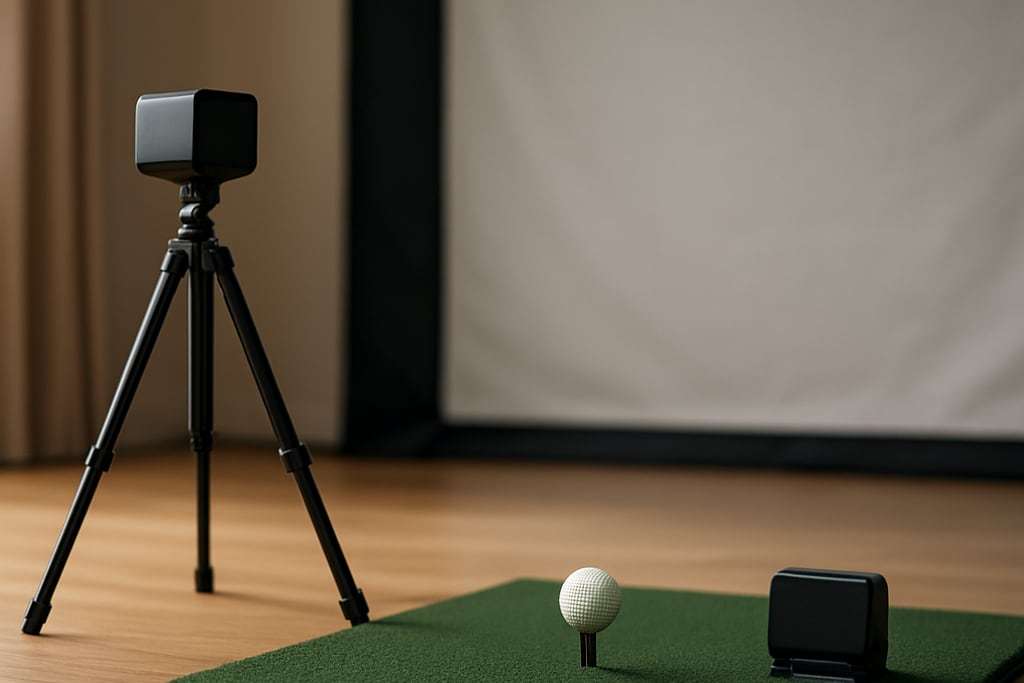
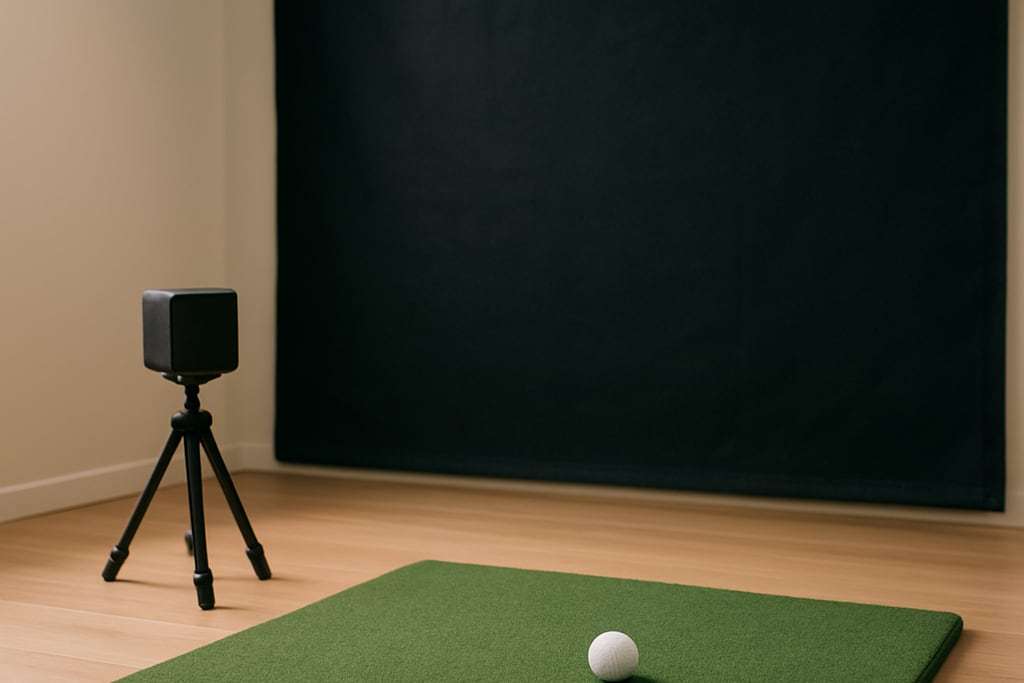
Radar monitors such as the Garmin R10 and Rapsodo MLM2PRO sit 6 to 8.5 feet behind the ball and push the room toward 16 to 19 feet deep. Camera monitors that sit beside the ball are listed at 12 to 13 feet wide and 15 to 16 feet deep, and overhead units need a 9 to 10 foot mounting height. Seller guides disagree, so use these as planning figures.
Room size changes with the launch monitor, because the monitor decides where the ball has to be tracked from and how much space sits behind or above you. This page lists the placement and room figures for named monitors, then gives a ceiling chart by golfer height and club. The figures come from seller and maker guides, not from our own measurements, and the guides disagree with each other. Treat them as rules of thumb and swing your longest club in the real room. For a general answer first, see the room size guide.
By monitor type
Shop Indoor Golf groups monitors by type. Heights are ceiling heights.
| Type | Examples | Height | Width | Depth |
|---|---|---|---|---|
| Camera, beside the ball | Foresight GC3 and GCQuad, SkyTrak ST Max, Uneekor EYE MINI | 10 ft | 12 to 13 ft | 15 to 16 ft |
| Camera, ceiling mounted | Uneekor EYE XO2, ProTee VX, Trackman iO | 10 ft | 13 to 15 ft | 15 to 16 ft |
| Doppler radar, behind the golfer | Garmin R10, FlightScope Mevo Gen2, Full Swing KIT | 10 ft | 12 to 15 ft | 16 to 19 ft |
The two ends of the range are plain. A camera unit that sits beside the ball needs less depth. A radar unit behind you needs more.
By named monitor
These rows combine placement with room size. Each row says which seller or maker the number comes from.
| Monitor | Where it sits | Room notes |
|---|---|---|
| Garmin Approach R10 | 6 to 8 ft behind the tee | 7 ft swing clearance, 10 to 12 ft tee to screen, 9 to 10 ft ceiling (Carl’s Place) |
| Garmin Approach R50 | About 1.5 ft to the side of the tee | 9 ft clearance around the golfer (Carl’s Place) |
| Rapsodo MLM2PRO | 6.5 to 8.5 ft behind the ball | 9 ft around the golfer; taller players may need to sit farther back (Carl’s Place) |
| FlightScope Mevo family | 4 to 7 ft behind the ball (FlightScope); Carl’s Place lists 8 ft from unit to tee for the Gen2 | About 8 ft of ball flight indoors (FlightScope) |
| Full Swing KIT | 10 ft behind the tee | More space gives more data (Carl’s Place) |
| SkyTrak, Foresight GC3, GCQuad | Beside the ball | 7 ft around the golfer, 9 to 10 ft ceiling (Carl’s Place) |
| Uneekor EYE MINI | Beside the ball; no specific placement stated by Uneekor or Carl’s Place | 7 ft around the golfer (Carl’s Place) |
| Bushnell Launch Pro | Beside the hitting area, about 2 ft from the ball in one guide | 10 to 12 ft wide, 10 to 18 ft deep, 9 ft ceiling in most guides (PlayBetter and sellers) |
| Square Golf Home and Omni | Beside the ball | About 10 ft wide, 10 ft deep, 9 ft high (PlayBetter) |
| Uneekor EYE XO2 | Overhead, 3.5 ft in front of the tee | 9 to 10 ft up, 13 ft swing circle, 12+ ft to screen (Carl’s Place) |
| Trackman iO | Overhead, about 3 ft 3 in in front of the tee | Mount 9 ft 4 in to 10 ft, turf at least 6 ft by 5 ft (Carl’s Place) |
| ProTee VX | Overhead | Mount 9 to 10 ft high; a retailer lists 9 ft by 12 ft by 16 ft (ProTee, Rain or Shine) |
Three caveats. Sources disagree on Square’s side offset (one listing says 42 cm from the ball and 15 cm forward, an article about the original Square says 42 cm and 23 cm), so read the maker’s setup page. Bushnell figures range from 10 feet wide and 10 feet deep to 18 feet deep depending on the seller. And the Mevo row comes from the maker’s own FAQ, which gives separate figures for wedges (4 feet) and drivers (7 feet), while Carl’s Place and Rain or Shine give larger depths.
Depth, added up
Radar depth comes from two numbers. Using Carl’s Place and the sellers’ 10 to 12 feet from tee to screen, the Garmin R10 works out to roughly 16 to 20 feet. The MLM2PRO is about 16.5 to 20.5 feet. The Full Swing KIT is 20 to 22 feet. This is simple arithmetic on published numbers, before any space behind the screen, so it is a planning figure and not a requirement from any maker.
If your room is shorter than that, the radar versus camera guide explains why a camera unit fits where radar will not. The launch monitor guide sorts models by room.
Ceiling chart by golfer height
Golfer’s Authority gives these ceiling heights by golfer height. They are rules of thumb, and they assume a full swing.
| Golfer height | Suggested ceiling |
|---|---|
| Under 5 ft 6 in | 8.5 to 9 ft |
| 5 ft 6 in to 6 ft | 9 to 10 ft |
| 6 ft to 6.5 ft | About 10 ft |
| Over 6.5 ft | About 11 ft |
| Mixed group (6 ft 5 in and 5 ft 8 in) | 10 to 10.5 ft |
Rapsodo is a little more specific for shorter golfers. It says a golfer about 5 feet 8 inches or below might be fine at 9 feet, while taller golfers need 10 or 11 feet because of longer clubs and higher swing arcs.
Ceiling chart by club
Club choice matters as much as height.
| Club | Ceiling |
|---|---|
| Irons and wedges | 8.5 to 9 ft |
| 8 ft ceiling | Irons only |
| 9 ft ceiling | Risk of touching longer clubs |
| Woods and driver | 10 ft minimum |
| Any club, any golfer | 10 to 12 ft |
Where a golfer’s height row and a club row give different numbers, use the higher one. A tall golfer with only a wedge still needs the tall golfer’s clearance, and a short golfer with a driver needs the driver’s.
Adjust the chart for your room
- Add 6 to 9 inches above the top of your swing. Rapsodo and Golfer’s Authority both give this margin.
- Add 2 to 3 inches for the mat. Golfer’s Authority’s example is a 9 foot ceiling minus 2 inches of foam, which leaves 8 feet 10 inches.
- Measure at the hitting spot, not at the wall, and note the lowest obstruction there, including pipes, ducts, beams and light fixtures.
- Sloped ceilings add 6 to 9 inches to the recommendation, measured at the highest point of the swing.
- Overhead monitors need their own height. The Uneekor and Trackman mounts above want 9 to 10 feet, so check that the mount and your swing path do not compete for the same space.
To check your own swing, take your longest club to the planned spot and make slow practice swings. Rapsodo suggests marking the club tip at the top of the backswing and the follow-through with chalk or tape, then comparing the marks to the ceiling. If any part of the swing touches the ceiling, the room is too low. The ceiling height guide walks through it, and the room size calculator turns your own height into a result.
Safety notes
Ball rebound, ceiling strikes and side clearance are real risks. Carl’s Place advises about 7 feet of clear space around the golfer (9 feet for the Garmin R50 and Rapsodo), and netting vendors advise at least 1 foot of buffer behind and beside netting. Keep people, pets and furniture out of that circle, and cover hard objects such as pipes. Nothing here makes a setup safe. Measure your swing, test with slow swings first, and ask a qualified contractor about any structural change to a ceiling.
Reusing these tables
You are welcome to copy these tables onto your own page, forum post or video description. Please link back to this page (golfsimathome.com, Launch Monitor Space Requirements) and keep the line that the figures come from sellers and makers and that they disagree.
Frequently asked questions
Why do radar launch monitors need a deeper room than camera ones?
A radar unit sits behind the golfer and needs the ball to fly far enough to be tracked, so the room has to hold the space behind you plus the flight to the screen. Shop Indoor Golf's table puts radar at 16 to 19 feet of depth against 15 to 16 feet for camera models that sit beside the ball.
How high does the ceiling need to be for an overhead monitor?
Carl's Place lists the Uneekor EYE XO2 and the Trackman iO as hung 9 to 10 feet above the hitting surface, and ProTee says the VX should be mounted 9 to 10 feet high. That is the unit's own height, so your ceiling has to clear your swing as well.
How far behind the ball does a Garmin R10 sit?
Carl's Place says the R10 must be placed 6 to 8 feet behind the tee. Add the 10 to 12 feet from tee to screen that sellers recommend and the room is roughly 16 to 20 feet deep before the space behind the screen. That sum is our own arithmetic from two published numbers.
What ceiling height do I need if I am 6 feet tall?
Golfer's Authority puts golfers from 5 feet 6 inches to 6 feet at 9 to 10 feet and golfers from 6 to 6.5 feet at about 10 feet. That is for a driver. A mat adds 2 to 3 inches, so measure your own swing before you buy.
Can I reuse these tables?
Yes. You may copy the tables on this page into your own site, forum post or video description as long as you link back to this page and keep the note that sellers disagree on these figures.
Sources
- Carl's Place: measuring your space for an indoor golf simulator
- Shop Indoor Golf: how much space do you need for a golf simulator
- Golfer's Authority: golf simulator ceiling height requirements
- Rapsodo: recommended ceiling height for a golf simulator
- ProTee United: how ceiling height affects the VX
- FlightScope: frequently asked questions