The short answer
Published guides put the minimum width at about 10 feet, 12 feet as recommended and 14 or more as ideal. Below 10 feet you are in compromise territory: one handedness, a smaller screen and a monitor chosen for the width, not the depth. A few enclosure packages are built for rooms under 9 feet wide.
Left-handed golfers mirror the layout. If you hit from off-centre, each side still needs room for the swing: check the nearer wall first.
Plenty of rooms are long enough for a simulator but too narrow to feel comfortable: a garage bay beside the car, a hallway-style office, a basement strip between a wall and the stairs. If that is your room, the usual advice about depth is not your problem. Width is, and the published numbers say where it stops being a minor squeeze and becomes a real limit.
What the guides say about width
The guides put the width in tiers, and the top tier is higher than most people expect.
| Source | Minimum | Recommended | Ideal |
|---|---|---|---|
| Shop Indoor Golf | 10 ft | 12 ft | 14 ft or more |
| TruGolf, general | 10 ft | 12 to 16 ft | not stated |
| Carl’s Place | 10 ft with an offset hitting area | not stated | 14 ft or more to center the tee |
| Rain or Shine Golf | 12 ft (basic setup) | 12 ft | not stated |
TruGolf’s model table has smaller entries: a Starter 10 minimum of 10 ft wide and a Vista 8 minimum of 9 ft wide. That is the floor for those specific systems, not a general rule.
If you have 10 ft or more, you are in the working range. Below 10 ft, treat anything you read as an upper limit to check against your own swing, not a promise.
Where the side clearance goes
The width number has to cover more than the golfer. Carl’s Place plans for about 7 ft of clearance in every direction around the golfer, which is a swing circle of roughly 14 ft across if you take it literally. The guide says 9 ft is listed for the Garmin R50 and Rapsodo. A 10 ft wide room cannot give you that on both sides, which is why Carl’s Place says 10 ft works only with an offset hitting area.
Other things also eat width:
- The screen and its frame. Golfer’s Authority says a screen 10 to 12 ft wide needs at least 12 ft of room width including about 1 ft of buffer on each side. Netting vendors also advise at least 1 ft behind and to the sides of the netting.
- The enclosure. Shop Indoor Golf lists an enclosure width of at least about 10 ft with at least 6 in of buffer each side.
- A side-mounted monitor and its stand. Anything beside the ball sits inside the same width.
If a wall is closer than the circle, move the hitting area off-centre so the golfer has more room on the side with the follow-through. That is the offset tee Carl’s Place mentions. It favors one hand, so if you have a left- and a right-hander, read the mixed-handedness guide.
Pick the monitor for the room you have
Radar and camera monitors spend space differently, and neither is a free pass in a narrow room.
Radar behind the golfer. Radar sits 6 to 8 ft behind the golfer and needs 16 to 21 ft of depth, with about 14 ft of width, according to Golfer’s Authority. Shop Indoor Golf’s table lists radar units at 12 to 15 ft wide. Examples are the Garmin Approach R10 ($499.99) and the FlightScope Mevo Gen2 (from $1,149). Radar is a poor match for a room under 12 ft wide.
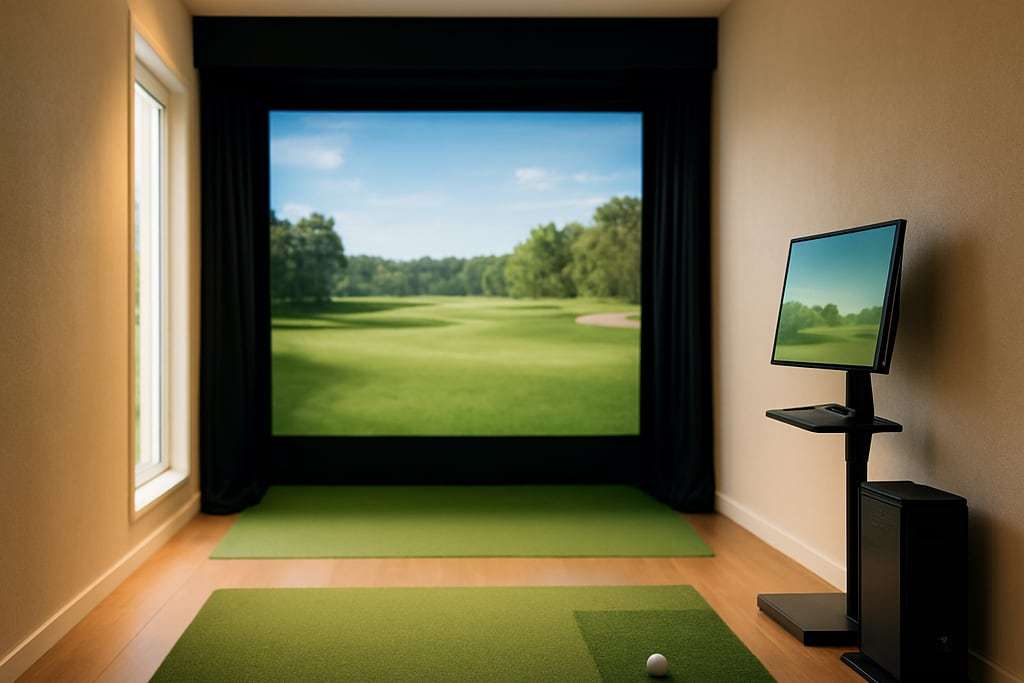
A camera unit beside the ball. Golfer’s Authority puts photometric setups at about 10 ft wide and 10 ft deep for a solo golfer, and the Square Golf Home ($699.99) is listed with almost no depth needed behind the golfer. Shop Indoor Golf’s table is less generous: it lists beside-the-ball units such as the Foresight GC3 and Uneekor EYE MINI at 12 to 13 ft wide by 15 to 16 ft deep. The two sources disagree, so ask the maker for the exact unit’s room size.
Overhead cameras keep the floor clear but need a tall ceiling, and Carl’s Place recommends a 13 ft diameter swing space with the player centered for the Uneekor EYE XO. That is a width problem in a narrow room. See the room size guide for how the layouts compare.
Enclosures built for a tight width
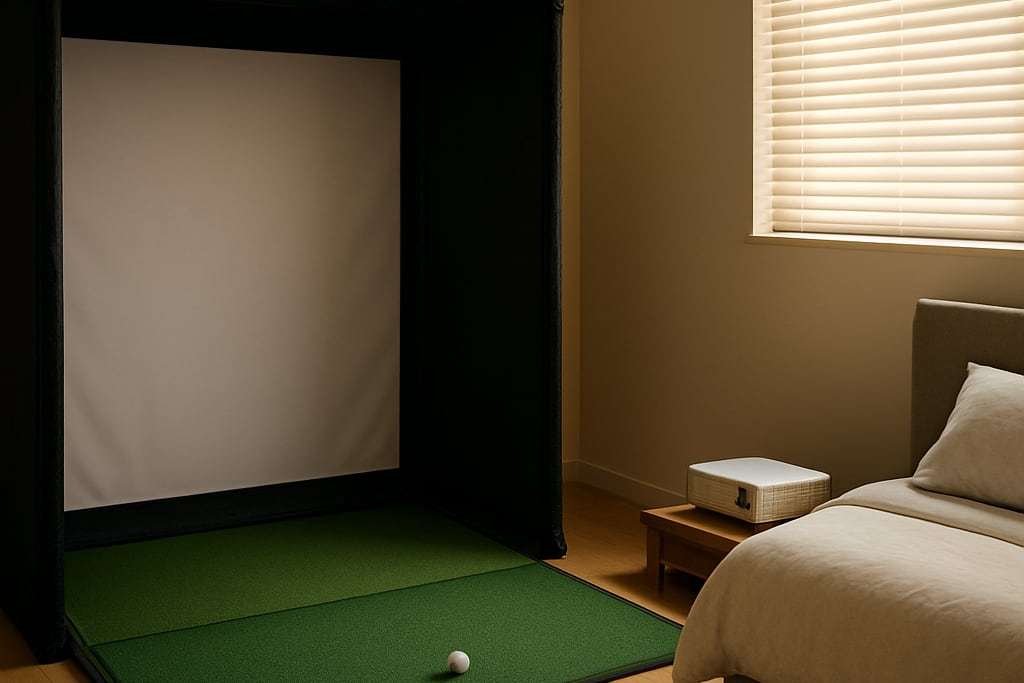
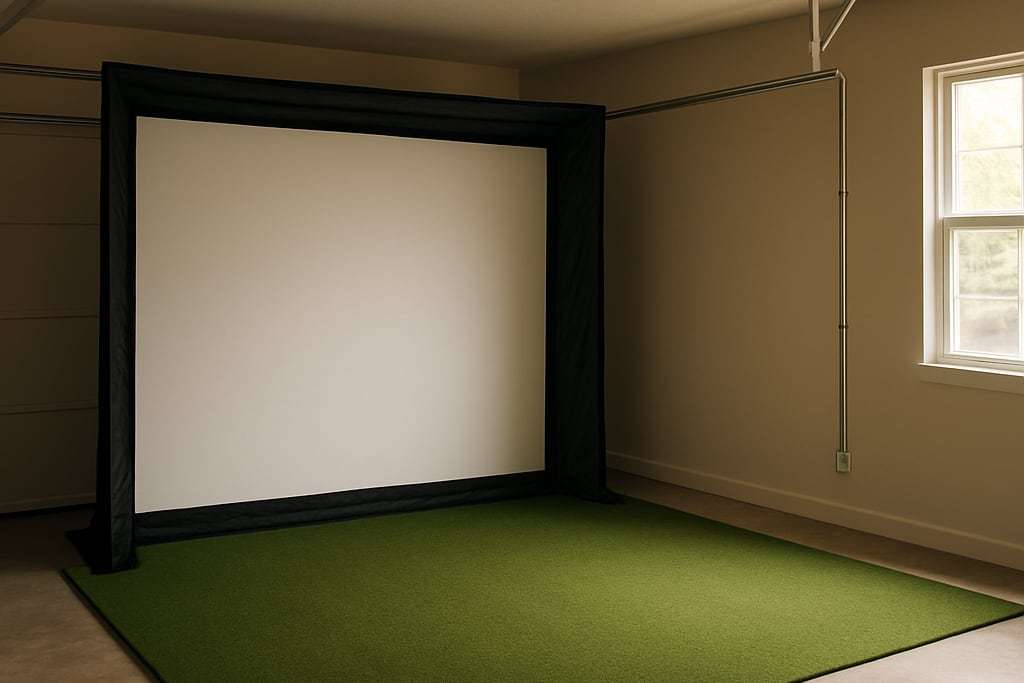
A few packages target narrow rooms directly. The MLM2XPRO SIG8 package ($2,899.99) uses an enclosure with a frame 8 ft 4 in wide and 8 ft 4 in high and a viewable screen of 7 ft 7 in by 7 ft 7 in. The listing says it is made for rooms under 9 feet wide and tells buyers to plan depth behind the mat. Note the frame height: it needs a ceiling clearly above 8 ft 4 in.
The Square Omni SIG DIY package (from $2,899.98) is the same kind of compact setup in several sizes. Projector and mat may cost extra. See the small-room picks for products matched to short rooms.
A 4:3 screen can help
Screen shape matters more than people expect. BenQ says a 4:3 screen is taller and suits rooms with limited width, because it maximises height. 16:9 is the most common ratio and needs plenty of width. A forum builder reports a 12 ft wide garage fit a 4:3 screen while a 16:9 one would have been shorter.
The catch is pixels. BenQ’s figures show a 1920 x 1080 projector showing 4:3 becomes 1440 x 1080, and a 4K projector becomes 2880 x 2160. That is roughly 25 percent of pixels lost from a 16:9 source, by our arithmetic on those numbers. A 16:10 source loses less.
Short swings and honest limits
A narrow room invites a shortened swing, and a shortened swing changes the data. If your follow-through hits a wall or a screen frame in a slow test, the room does not fit the shot you hit outside. Use the room for the swings it supports, keep the area clear of furniture, and stop if a swing ever gets close to a wall, a frame or a person.
Safety matters more when space is tight. Forum builders name hard objects such as support pipes as the main rebound hazard and say soft coverings keep rebounds weak, so pad any frame the ball can reach. Keep children and pets out of the swing zone and out of the room while someone is hitting.
A quick test before you buy
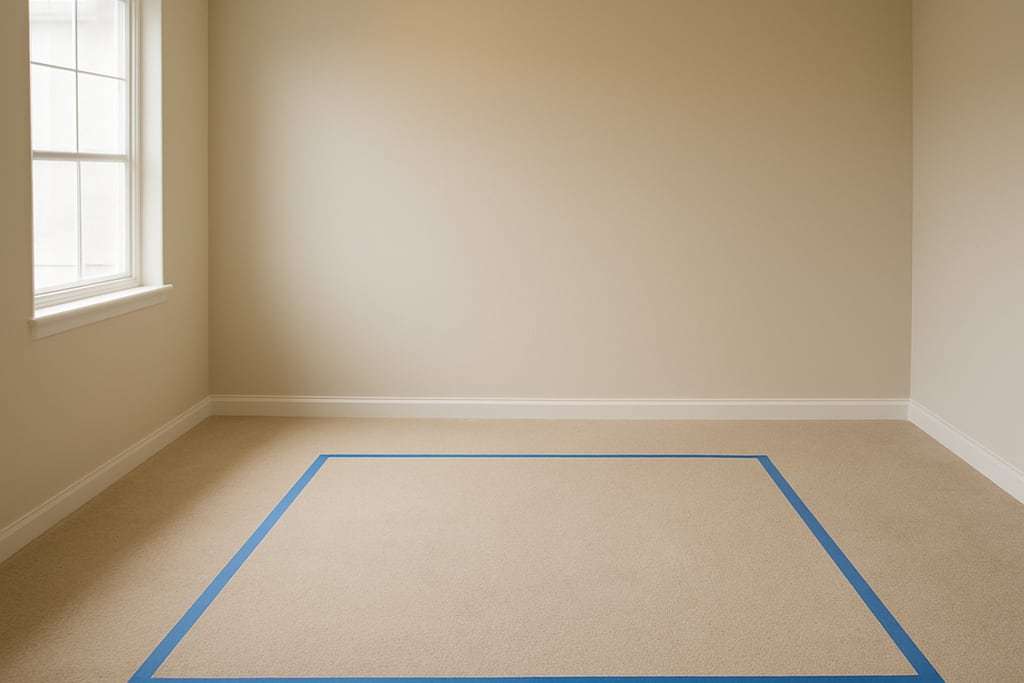
- Measure the width at shoulder height at the hitting position, not just at the wall.
- Take your longest club and swing slowly in both directions. If you play both hands, test both.
- Mark the club tip and note whether it touches a wall, a pipe or a frame.
- Compare the width to the table above and to the maker’s room table for the exact system.
- Use the room-size calculator for a quick yes or no, then the garage build plan if the narrow room is a garage bay.
If the room does not clear a slow swing, the product choice is not the problem. Pick a wider room, or use the narrow one for putting and short game.
Frequently asked questions
What is the minimum room width for a golf simulator?
Shop Indoor Golf's table lists 10 ft minimum, 12 ft recommended and 14 ft or more ideal. TruGolf lists a 10 ft minimum for its Starter 10 model and 9 ft for its Vista 8. Carl's Place says 10 ft works only with an offset hitting area.
Can I fit a simulator in a room under 10 feet wide?
Possibly, with trade-offs. The SIG8 enclosure in Shop Indoor Golf's MLM2XPRO package is sold for rooms under 9 ft wide, and its frame is 8 ft 4 in wide. You will have little side clearance, so measure your own swing before you buy.
Is a 4:3 screen better in a narrow room?
BenQ says a 4:3 screen is taller and suits rooms with limited width because it maximises height. A forum builder reports a 12 ft wide garage fit a 4:3 screen while a 16:9 one would have been shorter. A 4:3 image from a 16:9 projector loses pixels, so check the maths for your projector.
Should I choose radar or a camera monitor for a narrow room?
Radar needs 16 to 21 ft of depth and about 14 ft of width according to Golfer's Authority, so it suits a narrow room poorly. A camera unit beside the ball needs less depth, but Shop Indoor Golf still lists 12 to 13 ft of width for the units in its table. Confirm the room size for the exact model.
How much space do I need around the golfer?
Carl's Place plans for about 7 ft of clearance in all directions around the golfer, and 9 ft for some units such as the Garmin R50 and Rapsodo. Keep people and furniture outside that circle.
Sources
- Shop Indoor Golf: How much space do you need for a golf simulator
- Carl's Place: Measuring your space for an indoor golf simulator
- TruGolf: Golf simulator room dimensions
- Golfer's Authority: Golf simulator space requirements
- BenQ: Golf simulator projector aspect ratio
- Golfer's Authority: Photometric vs radar launch monitor